| Question | Short Answer |
|---|---|
| Is Agave utahensis the most cold-hardy agave? | In cultivation it is the cold-hardy extreme, with dry plants surviving brief drops to about −25 °C and occasional reports to −28 °C. |
| How big does Agave utahensis get? | Mature rosettes are compact, usually 30 cm to 50 cm wide with narrow grey-green to glaucous leaves. |
| Which Agave utahensis variety is showiest? | Var. |
| How do you propagate Agave utahensis? | Offsets are most reliable. |
Agave utahensis Engelm., the Utah agave, was described by George Engelmann in 1871 from material collected in southwestern Utah. The species occupies the high deserts of the Mojave and Colorado Plateau region, with populations across Utah, Nevada, Arizona, eastern California, and the northwestern corner of New Mexico, on limestone and sandstone slopes between roughly 600 and 2,500 m. Among horticultural agaves it is the cold-hardy extreme of the genus. Established plants with bone-dry roots have come through brief dips to -25 to -28 °C, the practical limit any agave can claim, and that single fact is why the species sits in any serious cold-climate succulent collection.
The native landscape is harsh in a different sense from the Mexican mountain agaves. A. utahensis belongs to thin rocky soils on slickrock benches, canyon rim ledges, and sun-baked talus, where winter snow is brief, summer rain falls in pulses, and surface water leaves within hours. Limestone is dominant, with sandstone outcrops in the Colorado Plateau half of the range. Daytime summer highs above 35 °C are routine, and winter nights below -15 °C are not unusual. The species is listed as Least Concern by the IUCN, but local populations are slow-growing and easily damaged by collecting pressure and off-road vehicle traffic on the same rim shelves where it grows.
Part of the Complete Agave Guide.
Identification
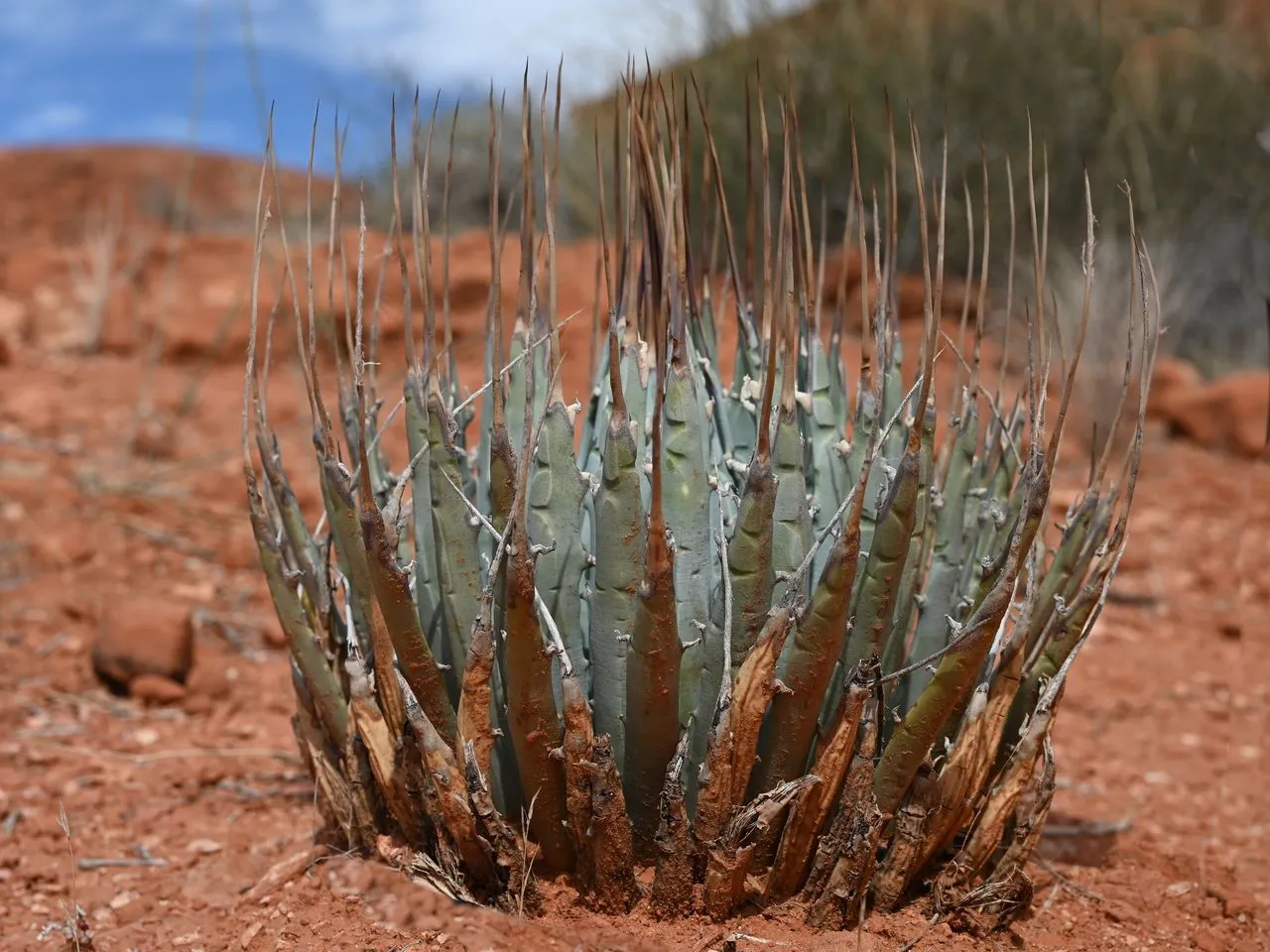
A mature A. utahensis forms a compact rosette 30-50 cm wide, considerably smaller than most ornamental agaves. The leaves are narrow, stiff, and grey-green to glaucous blue-grey, typically 15-30 cm long and 2-3 cm wide, channelled on the upper surface and lightly keeled below. The overall outline is open in young plants and tightens with age into a hemispherical to almost globose form. Plants grown in shade lengthen and lose the compact silhouette, so habitat photographs and well-grown specimens look quite different from material kept under cover in a temperate nursery.
The marginal teeth are sharp and prominent for a rosette of this size. They are pale to grey-brown, set at irregular intervals along the leaf edge, and large enough to draw blood when handled without gloves. The terminal spine is the second hazard: a long, slender, pale to grey-brown point that can extend 3-7 cm in some varieties and remain straight along the leaf axis. Combined with the hard mineral leaf surface, those armaments make the plant uncomfortable to repot and easy to recognise in a mixed collection.
Several recognised varieties carry the species across its range. Var. utahensis, the typical form, is the smallest and tightest, grey-green with shorter teeth and a moderate terminal spine. Var. eborispina, the "ivory spine" form from the more arid Mojave habitats of southern Nevada and adjacent California, carries longer, paler, almost white terminal spines and slightly broader leaves; it is the variety most often offered in the trade as an ornamental. Var. nevadensis represents the larger Nevada Mojave material, with broader rosettes approaching 50 cm and a slightly more open posture. Var. kaibabensis from the Grand Canyon area on the Kaibab Plateau is the broadest-leaved form, larger overall, and adapted to higher elevation. The four behave differently in cultivation: eborispina is the showiest, kaibabensis is the most forgiving in containers, and the typical form is the most cold-tolerant and the slowest.
Flowering is monocarpic and slow. After 20-40 years a rosette throws an unbranched yellow-flowered panicle 2-3 m tall, then dies. Because the plant suckers freely from the base, the clump survives the event. Offsets accumulate around the parent and form dense clusters over time, especially in well-drained ground.
Three lookalikes turn up in trade and in the field. Agave parryi is the closest behaviourally because it shares similar dry-cold tolerance, but it forms a much larger 60-90 cm rosette with broader, less heavily armed leaves and a calmer overall outline; it reads as a smooth blue-grey artichoke compared with the spiky A. utahensis. Agave montana matches A. utahensis on cold tolerance for completely different reasons, sitting in cool Mexican cloud forest at much higher elevation; it is also far larger, with broad green leaves and bold bud-imprints rather than narrow grey-green leaves with prominent teeth. Agave lechuguilla shares a narrow-leaved silhouette and the southwestern arid range, but its leaves are taller, narrower, more upright, and yellow-green, and its cold tolerance falls well short of A. utahensis. If a plant labelled Utah agave has leaves longer than about 40 cm and a soft light-green colour, check it against A. lechuguilla before trusting the name.
Cultivation
Light should be the strongest the site can offer. In its native range A. utahensis sits on open ledges with no overhead shade for most of the day. In garden cultivation, full sun all year is appropriate in temperate, Mediterranean, and continental climates. Indoors, the plant needs an unobstructed south-facing window or a strong grow light; anything less produces longer, paler leaves and an open rosette that loses the species' character. The compact form is a light-driven trait, not a genetic constant.
Water during active growth and stop early. In a 15-20 cm terracotta pot in warm weather, water deeply when the substrate is dry to a depth of 4-5 cm, typically every 14-21 days. In cooler conditions intervals stretch to 4-6 weeks. From late autumn through winter, give almost nothing. The species evolved with sub-freezing winter nights and dry roots; if the root zone stays damp through a hard frost, the plant freezes from the inside out and rots at the crown when it thaws. The cold hardiness numbers above only apply to bone-dry plants. A wet A. utahensis at -10 °C is in much more trouble than a dry one at -25 °C.
Substrate should be aggressively mineral. A useful container mix is 75-85% mineral material, including pumice, scoria, coarse limestone or dolomite chips, and expanded shale, with the balance as a low-peat loam-based compost. The limestone fraction matches the alkaline rock the plant evolved on. For open-ground plantings, raised mineral beds, rock crevices, or south-facing slopes are essentially mandatory in any climate that receives winter rain. Flat ground in heavy soil kills this species more reliably than any frost.
Temperature tolerance is the species' headline. Established plants with dry roots have survived brief drops to -25 °C with cosmetic leaf damage and recovered fully, and isolated reports extend to -28 °C under exceptional drainage and overhead protection. Those numbers represent the genus ceiling, not a routine target. In practice, treat USDA zone 5b to 6 as the cold edge for unprotected dry-sited plants and zone 7 as comfortable. The bigger threat in most temperate gardens is winter wet rather than absolute minimum.
Pot size should stay tight. A. utahensis has a modest fibrous root system and resents large volumes of damp substrate. Start young plants in pots only 2-3 cm wider than the root ball and shift up only when the rosette and its offsets fill the pot surface. Terracotta is preferable in cool, humid climates because the porous wall accelerates drying. Feed lightly: a low-nitrogen fertiliser at one-quarter label strength once in spring is enough for most container plants, and outdoor specimens in mineral soil rarely need any feed at all. Heavy feeding produces longer, softer leaves and breaks the compact form.
Propagation
Offsets are the most reliable method for this species and the one most growers use. Mature clumps produce pups freely from the base, often pressing against the parent rosette in dense clusters. Wait until an offset has its own roots and is at least 5-7 cm across before separation. Sever the connecting stolon cleanly, leave the wound to dry for 7-10 days in a cool shaded place, and pot into dry mineral mix. Hold off watering for another 5-10 days, then resume light irrigation. Rooted offsets typically resume growth within 6-10 weeks in warm conditions and reach a recognisable young rosette in 18-30 months.
Seed works for genetic diversity but is slow even by agave standards. Fresh seed germinates in 14-28 days at 20-25 °C on a fine mineral surface with light coverage. Seedlings emerge as thin grass-like cotyledons and only gradually take on the species' compact toothed character. Expect 3-5 years before a seedling fills a 9 cm pot and considerably longer for a presentable specimen. Use seed when buying material from a botanical-garden source to be sure of variety identity, since trade clones labelled "var. eborispina" often turn out to be intergrades or other forms entirely.
Detached leaves do not root. Agaves in general lack the regenerative cells that drive leaf-cutting propagation in echeverias and many sedums, and A. utahensis is no exception.
Notes
The most common failure I see with this species is over-potting and over-watering by growers used to easier agaves. A. utahensis in a litre of damp peat-rich compost looks fine for one growing season and dies in the second. The rosette signals the problem with longer, softer leaves and a slight outward flare; by the time the central spear blackens, the crown is already lost. If a plant looks loose and pale, repot into a smaller container of coarse mineral mix and reduce watering before doing anything else.
Pests are mostly secondary on this species. Mealybugs occasionally hide deep among the offsets, and scale appears on plants in still air. Both are visible to a careful inspection but easy to miss in a tight cluster of pups. The agave snout weevil rarely attacks rosettes this small. Outdoor plants in deer country sometimes have leaf tips browsed in hard winters; the resulting damage is cosmetic, and the marginal teeth eventually deter further attention.
For broader watering, light, and substrate practice that frames why A. utahensis behaves the way it does in cultivation, see the beginner's guide alongside the Complete Agave Guide.
See also
- Complete Agave Guide - genus-level cultivation, hardiness, and propagation context.
- Agave parryi - larger, smoother rosette with similar dry-cold tolerance.
- Agave montana - Mexican cloud-forest agave with a different route to comparable cold tolerance.
Frequently Asked Questions
Is Agave utahensis the most cold-hardy agave?
In cultivation it is the cold-hardy extreme, with dry plants surviving brief drops to about −25 °C and occasional reports to −28 °C.
How big does Agave utahensis get?
Mature rosettes are compact, usually 30 cm to 50 cm wide with narrow grey-green to glaucous leaves.
Which Agave utahensis variety is showiest?
Var. eborispina is the ornamental favourite because it carries longer, pale, almost white terminal spines.
How do you propagate Agave utahensis?
Offsets are most reliable. Wait for rooted pups 5 cm to 7 cm across, callus for 7 to 10 days, and pot dry.