| Question | Short Answer |
|---|---|
| Why do Sempervivum globiferum chicks roll away? | The fragile stolons detach at maturity, letting spherical chicks move to open substrate. |
| How do I propagate Sempervivum globiferum? | Collect mature detached chicks and set them on gritty substrate. |
| How hardy is Sempervivum globiferum? | It is reliable to about −30 °C when dry and is grown outdoors in USDA zone 4 conditions. |
| How is Sempervivum globiferum different from S. heuffelii? | S. |
Sempervivum globiferum L. (hen and chicks, rollers) is another of the species that passed between Sempervivum and the segregate genus Jovibarba. Linnaeus originally described it in 1753, it spent most of the twentieth century in Jovibarba as J. globifera, and Kew's current treatment has pulled it back into Sempervivum. Many nurseries still sell it under the old name.
Part of the Complete Sempervivum Guide.
The species is native to the Alps, the Carpathians, and the Balkan ranges at 1,000–2,500 m, typically on calcareous or neutral rock. Its common name "rollers" comes from its uniquely mobile offsets: the chicks detach at full weight and roll away from the mother like small green marbles, a dispersal strategy that is unusual among the Crassulaceae and unique within the sempervivums.
Identification
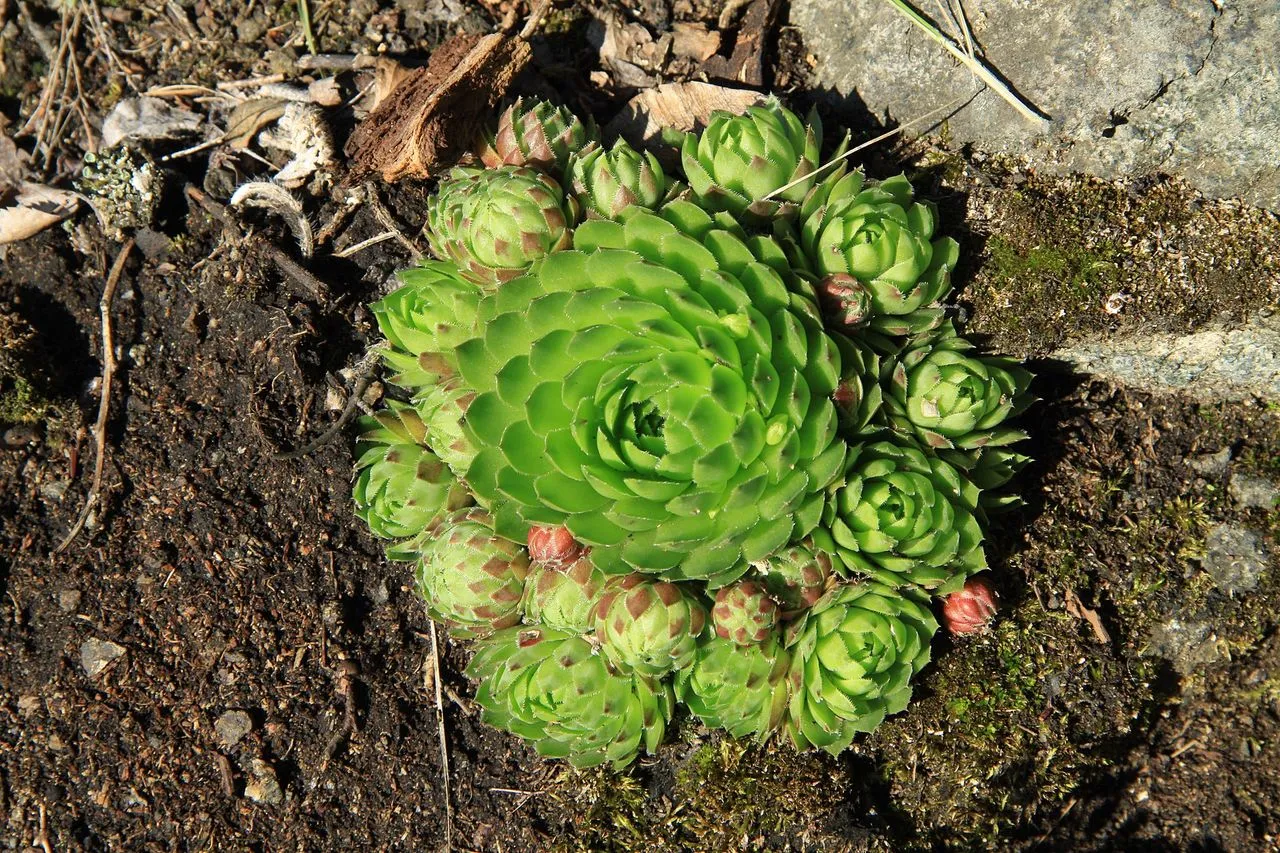
- Rosettes. 3–6 cm across, globose rather than flat, with the leaves curving inward to form a nearly closed ball in cold weather.
- Leaves. Oblong to oblanceolate, 1.5–3 cm long, glabrous with finely ciliate margins. Colour is mid-green with a pale red-brown tip in sun, intensifying in winter. Overall expression is more subdued than the brighter hybrids in the genus.
- Inflorescence. A scape 10–20 cm tall bearing bell-shaped, pendulous 6-petalled pale yellow flowers with ciliate (fringed) petal margins. Flowers are the key character that used to define Jovibarba: 6 bells versus the 12 flat-petalled pink stars of true Sempervivum.
- Offsets. The diagnostic feature. Chicks develop on short stolons, but the stolons are fragile and the chicks detach spontaneously at maturity. A mature chick is a nearly spherical rosette that sits loose on the substrate with no rooted connection, ready to roll, tumble, or be carried by rain or wind to a new position where it can root.
Cultivation
Cultivation is genus-typical with one peculiarity worth anticipating: if you grow S. globiferum in a container, the detached chicks will roll out of the pot. Expect to find stray chicks on the floor around the planter through summer and autumn. Collect them and replant in fresh substrate; they root easily.
The species tolerates calcareous substrate. Use the standard gritty alpine mix, optionally with 20% limestone chippings in the grit fraction. pH 6.5 to 7.5 is ideal.
Hardiness is USDA zone 4, reliable to around −30 °C dry. Summer heat is tolerated without complaint. Full sun is essential for tight globose rosette form; in shade the rosette flattens and loosens and the plant loses much of its visual distinctiveness.
Propagation
The species propagates itself. Collect the detached chicks in late summer or early autumn, place them onto gritty substrate (no need to bury, no callus needed), and they will root within 2–3 weeks. Do not pile multiple chicks on top of each other or the contact surfaces will rot.
You can also intervene earlier: when a chick is visibly mature on its stolon but has not yet detached, snip the stolon, pick up the chick, and place it where you want a new plant. Either method works.
Seed propagation is possible but slow and produces variable progeny. Most growers rely on the rolling chicks.
Notes and Quirks
The rolling-chick dispersal strategy is a functional trait, not a mistake. In the scree habitats where S. globiferum evolved, a chick that can roll a few metres from its parent on rainwater runoff has a much better chance of establishing on unoccupied substrate than one tethered to the parent by a persistent stolon. The trait also means the plant naturalises readily in appropriate sites — if you plant it in a wall or scree garden, expect it to migrate downslope over several seasons.
There are three named subspecies in modern treatments: subsp. globiferum (widespread), subsp. arenarium (small rosettes, eastern Alps), and subsp. hirtum (hairy, mainly Balkan). The distinctions are subtle and matter mainly to specialist collectors.
S. globiferum hybridises with S. heuffelii where ranges overlap, producing intermediate forms with partly rolling, partly crown-dividing offset habits. These hybrids are occasionally traded and are worth having for the taxonomic interest.
See also
- Sempervivum heuffelii — the other major former-Jovibarba species.
- Sempervivum montanum — similar compact alpine habit with conventional stolon offsets.
- The Complete Sempervivum Guide — genus overview and taxonomy context.
- Sempervivum tectorum — the conventional stolon-offset species for direct comparison.
Frequently Asked Questions
Why do Sempervivum globiferum chicks roll away?
The fragile stolons detach at maturity, letting spherical chicks move to open substrate. In scree habitats this spreads the clone downslope.
How do I propagate Sempervivum globiferum?
Collect mature detached chicks and set them on gritty substrate. No callus or burial is required.
How hardy is Sempervivum globiferum?
It is reliable to about −30 °C when dry and is grown outdoors in USDA zone 4 conditions.
How is Sempervivum globiferum different from S. heuffelii?
S. globiferum produces rolling detached chicks, while S. heuffelii divides at the crown and does not make stolon offsets.