| Question | Short Answer |
|---|---|
| How is Sempervivum heuffelii propagated? | Lift the plant in spring and cut between the new crowns, giving each division a share of roots. |
| Does Sempervivum heuffelii prefer limestone? | Yes. |
| How hardy is Sempervivum heuffelii? | It is reliable to about −30 °C when dry, with the usual need to keep the crown dry in wet winters. |
| Why is my S. heuffelii wrapped in papery leaves in winter? | That is normal active leaf turnover. |
Sempervivum heuffelii J.Schott (Hungarian or Heuffel's houseleek) is the odd one out in the genus. It was historically placed in the segregate genus Jovibarba on the basis of its distinct bell-shaped yellow flowers, and is still traded as Jovibarba heuffelii in many catalogues. Modern molecular work has partially pulled it back toward Sempervivum, but its generic position remains contested, and the British Cactus and Succulent Society currently accepts both names.
Part of the Complete Sempervivum Guide.
The species is native to the Balkans, the Carpathians, and parts of northern Greece, typically on limestone and dolomite cliff faces at 500–2,200 m. For the grower the taxonomic label matters less than two practical points: the plant has very different flowers to true Sempervivum, and it propagates by crown division, not by stolon offsets.
Identification
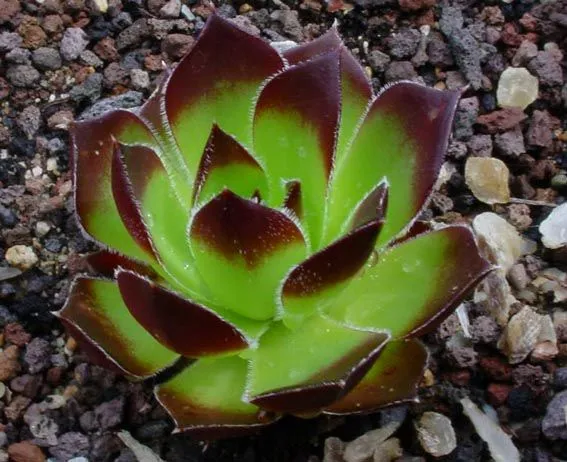
- Rosettes. 4–10 cm across at maturity, symmetrical and slightly cup-shaped, tightening into a ball in winter.
- Leaves. Oblanceolate to obovate, 2–4 cm long, with fine white ciliate margin hairs (a diagnostic character; run a fingertip along the leaf edge). Leaf surface is smooth. Colour ranges wildly across cultivars from olive-green to wine-purple, with many two-toned selections ("red outer, green centre" or inverse).
- Inflorescence. A scape 15–25 cm tall bearing bell-shaped, pendulous, pale yellow to greenish-yellow 6-petalled flowers with distinctly fringed (ciliate) petal margins. This is the character that historically defined Jovibarba — the 6-petalled bell is completely unlike the 12-petalled pink star of true Sempervivum.
- No offsets on stolons. This is the key propagation difference. The mother rosette divides at the crown itself, producing 2–4 new crowns packed tightly together. You will never see the "hen with chicks on stolons" pattern.
Cultivation
Cultivation is genus-generic with one meaningful adjustment: S. heuffelii is limestone-tolerant and actually prefers slightly alkaline substrate. Use the standard gritty alpine mix but incorporate limestone chippings as 30% of the grit fraction, or add a tablespoon of ground limestone per 2 L of mix. pH 6.5 to 7.5 is ideal.
The species is fully cold-hardy in USDA zone 4, reliable to around −30 °C dry. It benefits from the normal precaution of keeping the crown dry through winter in maritime climates.
One oddity: S. heuffelii is distinctly deciduous in its active leaf turnover. Through winter the rosette tightens to a dense ball and the outer leaves go papery; these papery leaves are not dead, they form a protective wrapping. Do not pull them off in winter. Wait until spring growth resumes and the plant will push them off itself. Picking them early exposes the living centre to cold wet damage.
Propagation
The crown-division mechanism means the offset-on-stolon technique used for every other Sempervivum does not apply. Instead:
- In spring when new growth is starting, lift the whole plant out of its substrate.
- Wash the roots clean and identify the distinct new crowns at the top of the root stock. A mature mother in cultivation typically holds 2–4 crowns after a good season.
- Use a sharp sterile knife to cut straight down between the crowns, taking roughly equal portions of the root mass with each division.
- Dust the cuts with sulphur powder or let them dry in shade for 2–3 days.
- Repot each division in fresh gritty, slightly alkaline substrate. Water lightly.
Establishment takes 4–8 weeks. Expect some shock — the first month after division the rosettes will tighten up and stop growing while the root system re-establishes.
Notes and Quirks
The cultivar world around S. heuffelii is rich. There are hundreds of named selections, many of them very dark-pigmented, many with striped or zoned leaf patterns. Because the plant does not produce easily-separated chicks, cultivars build up commercial stock slowly and are usually more expensive than equivalent S. tectorum hybrids.
The flower shape is unmistakable. If you are ever unsure whether a plant is S. heuffelii or a standard Sempervivum, wait until it flowers; 6 bell-shaped petals versus 12 flat star petals settles it in seconds.
See also
- Sempervivum globiferum — the other Jovibarba-origin species in common trade.
- The Complete Sempervivum Guide — for the genus-level context on the Jovibarba taxonomy.
- Sempervivum montanum — another small-rosette cold-hardy alpine for comparison.
- Sempervivum tectorum — the most widespread stolon-offset houseleek, for contrast with heuffelii's crown-division method.
Frequently Asked Questions
How is Sempervivum heuffelii propagated?
Lift the plant in spring and cut between the new crowns, giving each division a share of roots. It does not make normal stolon offsets.
Does Sempervivum heuffelii prefer limestone?
Yes. It tolerates and prefers slightly alkaline substrate, with pH 6.5–7.5 and limestone chippings in the grit fraction.
How hardy is Sempervivum heuffelii?
It is reliable to about −30 °C when dry, with the usual need to keep the crown dry in wet winters.
Why is my S. heuffelii wrapped in papery leaves in winter?
That is normal active leaf turnover. Leave the papery outer leaves in place until spring growth pushes them off.