| Question | Short Answer |
|---|---|
| What makes Cereus forbesii Spiralis distinctive? | The stems twist in a spiral as they elongate, producing an architectural column rather than a straight ribbed stem. |
| How much light does spiral cereus need? | It needs the brightest position available indoors and direct sun after acclimation. |
| Does spiral cereus need a heavy pot? | Yes. |
| Can Cereus forbesii Spiralis be propagated by cuttings? | Yes. |
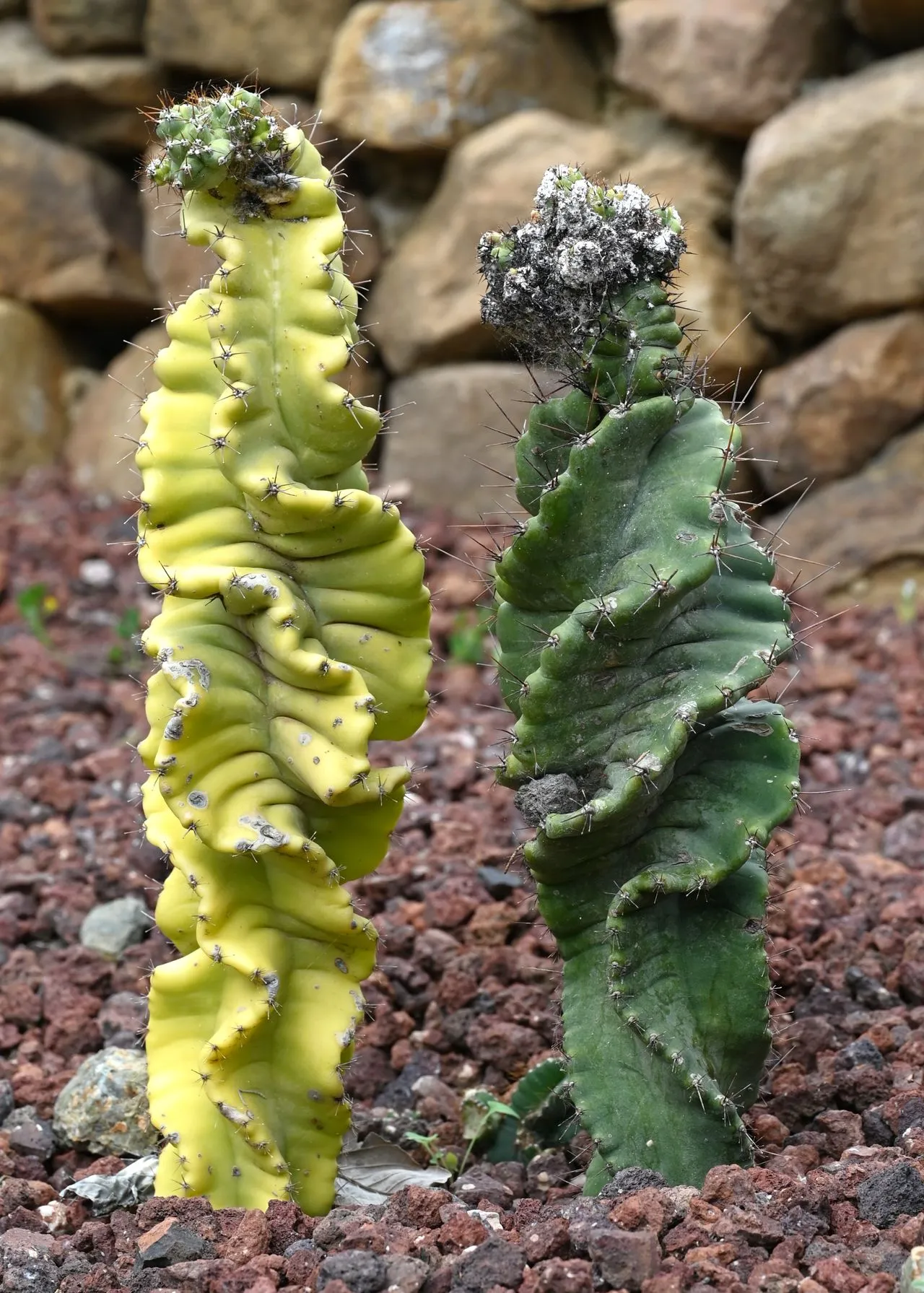
Cereus forbesii 'Spiralis', sold across European and North American nurseries as the Spiral Cactus or Twisted Cactus, is a cultivar of Cereus forbesii selected for ribs that climb the column in a slow contra-clockwise spiral instead of running vertically as in the wild type. It is not a wild form. Every plant in commerce traces back through vegetative cuttings to a small number of mutant individuals fixed in the trade during the 1980s and 1990s. Mature specimens reach 1 to 2 m in containers, occasionally taller in heated glasshouses or warm-zone gardens, with blue-green columns 7 to 12 cm in diameter. The rib count is one of the few cactus identifications where you can count to a different number twice on the same stem; because the helix compresses and releases as it climbs, the visible rib count along a single column drifts between 5 and 9.
The cultivar provenance is worth understanding because it separates C. forbesii 'Spiralis' from anything you might mistake it for. The original spiral mutation appeared in cultivated stock and was selected commercially in the 1980s; through the 1990s European cactus nurseries (notably in Germany, the Netherlands, and northern Italy) propagated it widely from cuttings, and by the early 2000s it had become a fixture in continental garden centres. Wholesale tissue-culture lines have since pushed the cultivar into mass retail, where it often appears under generic trade names like "Spiral Cactus" with no Latin label at all. The parent-species identity is debated. Some growers and references attribute 'Spiralis' to C. forbesii, others to C. peruvianus, and the binomial mess is partly because C. peruvianus itself is now usually treated as a synonym of Cereus repandus. The cultivar therefore travels under multiple parental labels even though the clones themselves are propagated from the same vegetative lineage.
Part of the Complete Cactus Guide.
Identification
Spotting C. forbesii 'Spiralis' is a one-feature identification: the ribs twist. On a healthy specimen the spiral is visible from the moment new growth pushes out at the apex, and the rotation continues up the entire column. The columns are blue-green to grey-green with a faint waxy bloom, less pronounced than on C. repandus but recognisable in oblique light, and the body diameter falls between 7 and 12 cm at maturity, more slender than a same-age non-spiraled species would be. Areoles sit on the rib crests carrying short brown to grey spines, usually 1 to 2 cm long, in clusters of 5 to 9. The spination is thinner than that of C. repandus and never approaches the dense bristle coat of smaller silver-torch relatives.
Flowers, when they appear, are funnelform, 8 to 14 cm long, white inside with pink to pinkish-red outer perianth segments, and they open at night for one or two evenings. Flowering is uncommon in the trade because nursery stock is sold and turned over young; mature outdoor plants in zone 9b and warmer can flower from about 1 m height onward. Fruit is ovoid, pinkish-red, splitting to expose white pulp with small black seeds. Most owners never see either.
The plants worth distinguishing on the shop floor:
- Typical Cereus forbesii. Identical body colour, identical spination, identical floral characters; the ribs run vertically with no twist. If you cannot see a clean spiral up the entire column, it is the straight species, regardless of what the label says.
- Cereus peruvianus 'Monstrose' (sometimes labelled "Cereus peruvianus monstrosus"; modern taxonomy assigns the monstrose form to C. forbesii or C. uruguayanus rather than C. repandus). This is an irregular knobbly mutation in which the rib structure breaks down into chaotic knobs and outgrowths. There is no spiral and no smooth ribbed sections; the surface looks like clenched fingers or melting wax. The two cultivars get cross-shelved in garden centres but the visual difference is unmistakable in person.
- Cleistocactus strausii. Narrower (typically 5 to 8 cm in stem diameter at the base), clad in dense white hair-like spines that produce a silvery cylindrical appearance. The rib count is much higher (around 25), and the spines form a continuous bristle covering rather than discrete clusters. Even a confused buyer rarely mistakes the silver torch for a spiral cactus once both are next to each other.
Cultivation
C. forbesii 'Spiralis' carries the same broad cultivation envelope as the parent species, which is one reason it survives mass retail with very little owner skill. It still rewards proper light. In growing season (roughly April to September in the northern hemisphere) it wants 5 hours or more of direct sun a day, ideally from a south or south-west window, or an outdoor position with morning to early-afternoon sun. In dim rooms the apex thins, the spiral loosens slightly because internodal stretch widens, and new growth fades to lighter green. Outdoors in Mediterranean climates the cultivar accepts full sun once acclimatised over 10 to 14 days; sudden moves from a shaded supermarket display into July sun cause beige sun scars that do not fade.
Watering follows the standard deep-soak then dry pattern. In summer, a 15 cm pot of mineral-heavy substrate housing a 50 cm specimen typically dries through in 10 to 14 days at room temperature; a moisture probe should read below 15% in the top 3 cm before the next watering. Pour until water runs from the drainage hole, then wait. From late autumn through winter, when night temperatures drop below 12 °C, taper to almost nothing; one cautious watering every 6 to 8 weeks keeps the roots alive without rotting them.
Substrate should be more mineral than the standard houseplant mix: 60 to 70% mineral material (pumice, lava rock, coarse grit graded 3 to 6 mm) and 30 to 40% low-peat compost works reliably. A wide terracotta pot with multiple drainage holes suits the cultivar's habit; the plant becomes top-heavy as it gains height, and a heavier pot prevents toppling once the column passes about 60 cm.
Temperature tolerance is broad on the warm side. Mature plants accept 35 to 40 °C in summer if their roots are healthy and they are not in fresh substrate that holds water. Cold tolerance is the boundary that catches owners. Treat -2 °C as a briefly survivable lower limit when the plant is bone dry; below that, the columnar tissue blackens at the apex and may rot internally as it warms back up. Aim to keep the plant above 5 °C through winter rest, and avoid any combination of cold and damp substrate. Brief exposure to -2 °C dry causes only cosmetic apex damage; the same temperature with wet roots usually kills the plant.
For broader cactus context and seasonal scheduling, see the Beginner's Guide to Succulents.
Propagation
Stem cuttings are the only reliable method for 'Spiralis'. Seed propagation does not preserve the cultivar because the spiral is a vegetative selection; seedlings from a 'Spiralis' fruit revert overwhelmingly to the straight non-twisted form, and it is the spiral that buyers want. The cultivar is therefore maintained worldwide through cuttings and (in newer commercial pipelines) tissue culture.
To take a cutting, choose a section 15 to 30 cm long with at least one healthy areole at the cut. Use a clean blade through firm tissue, ideally above an areole on the parent plant so the parent recovers cleanly with a new branch. Allow the cut surface to callus in a shaded, dry, airy position for 1 to 2 weeks (longer for thicker stems above 6 cm in diameter); the surface should feel pale, dry, and corky before potting. Insert the callused cutting upright into dry mineral substrate, support it with a stake or stones if it is heavy, and begin light watering once you sense resistance when you nudge the cutting (usually 3 to 6 weeks at 22 to 28 °C). Cuttings taken in late spring or early summer root more reliably than autumn cuttings and resume visible growth within the same season.
The spiral itself is preserved in cuttings because the rib geometry is set at the apex by genetic and cellular pattern, not by environmental cue. Every new section pushed by a rooted cutting will twist in the same direction (contra-clockwise) and at roughly the same pitch as the parent stem, with very minor variation between siblings.
Notes
The cultivar circulates globally as an architectural specimen, popular for its sculptural form on patios, in dry-style courtyard plantings, and indoors as a vertical accent. It tolerates indoor conditions better than most columnar cacti of its size class, which is partly responsible for its retail success.
Two trade-floor confusions are worth flagging. First, "spiral" is sometimes claimed for plants whose ribs show only a faint waver rather than a true helix; the cultivar 'Spiralis' produces a clean continuous twist, not a wobble. Second, the cultivar appears under both Cereus forbesii 'Spiralis' and Cereus peruvianus 'Spiralis' on labels, occasionally even Cereus validus 'Spiralis'; the underlying clones are usually the same vegetative lineage and the differences in the binomial reflect ongoing taxonomic disagreement rather than different plants. The plant is not toxic, and the spines are stout enough to discourage curious pets.
See also
- The Complete Cactus Guide, the broader Cactaceae context
- Beginner's Guide to Succulents, seasonal watering and substrate primer
- Cereus peruvianus, the closest commonly grown columnar relative without the spiral rib twist
- Cleistocactus strausii, the silver torch alternative for vertical accent
Frequently Asked Questions
What makes Cereus forbesii Spiralis distinctive?
The stems twist in a spiral as they elongate, producing an architectural column rather than a straight ribbed stem.
How much light does spiral cereus need?
It needs the brightest position available indoors and direct sun after acclimation. Low light produces weak, narrow growth.
Does spiral cereus need a heavy pot?
Yes. As the column gains height, a heavy container improves stability and reduces tipping.
Can Cereus forbesii Spiralis be propagated by cuttings?
Yes. Columnar cereus cuttings should callus before potting in dry mineral substrate.