| Question | Short Answer |
|---|---|
| What is Cereus peruvianus in cultivation? | The name is used in trade for Peruvian apple cactus plants, often treated around the Cereus repandus complex. |
| How big can Cereus peruvianus get? | It can become a house-height columnar cactus in warm climates, so young pots should be planned with future height in mind. |
| When do Cereus flowers open? | The guide describes Cereus as producing large night-opening flowers. |
| What light does Cereus peruvianus need indoors? | It needs the brightest position available. |
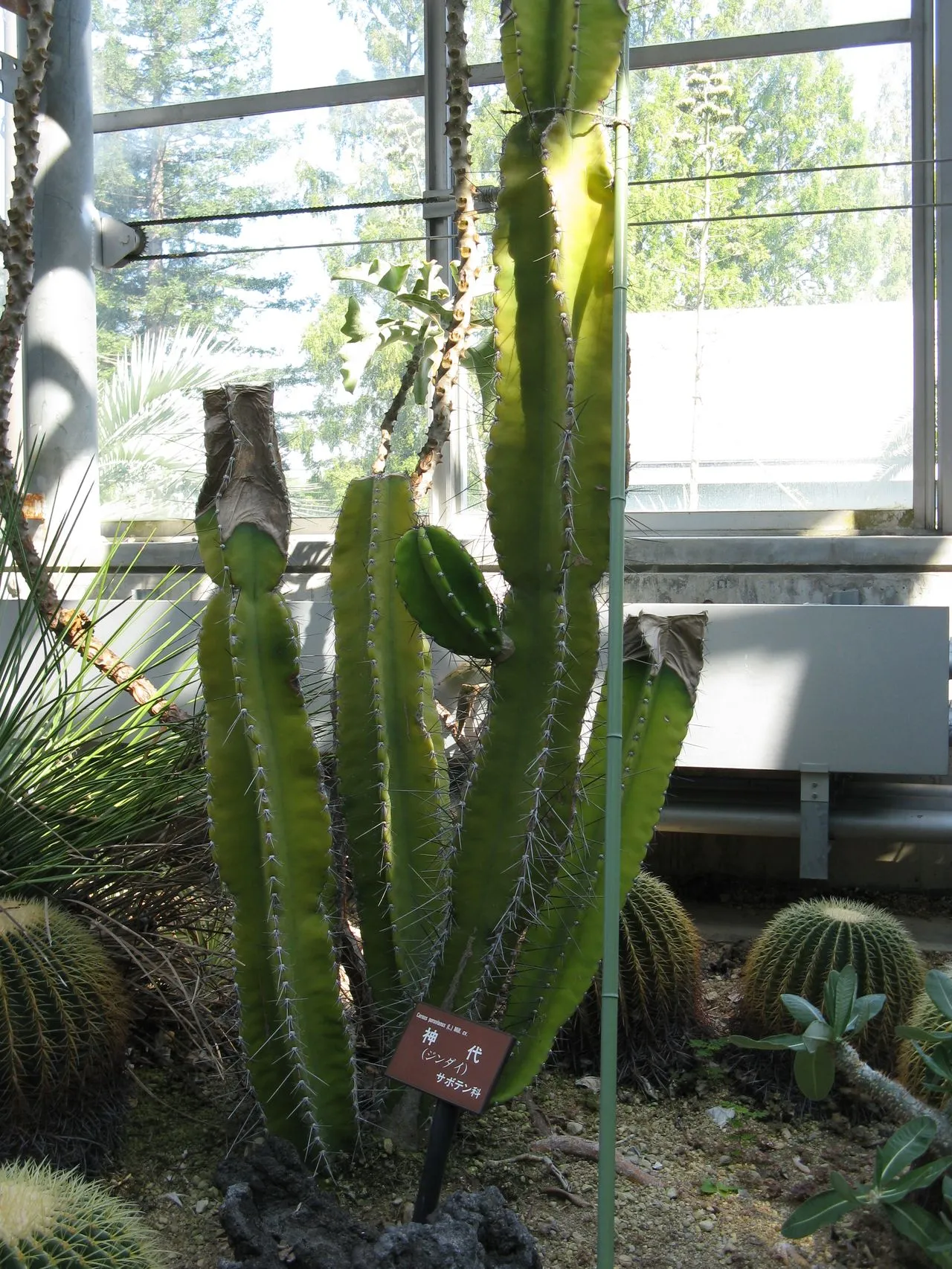
Cereus repandus, described by Linnaeus in 1753 and combined into the genus Cereus by Philip Miller in 1768, is the columnar tree cactus you meet in supermarkets as a 30 cm candle in a black plastic pot, and on Caribbean and Venezuelan coasts as a branched tree taller than a single-storey house. Its native range stretches from Venezuela and the southern Caribbean (Aruba, Curaçao, Bonaire) into Colombia, the Guianas, and northern Brazil, from sea level up to about 1,200 m. The defining features are the blue-green to grey-green ribbed columns, 12 to 20 cm in diameter with 6 to 9 prominent ribs, areoles carrying 5 to 10 stiff dark spines, and large white nocturnal flowers that mature into edible red-pink or yellow fruit known commercially as pitaya peruana.
In habitat, the species grows in dry to semi-arid scrub and open thorn forest, often on rocky limestone, calcareous loam, or sand over coral rubble, where annual rainfall is variable and concentrated in a short wet season. It is one of the dominant tree cacti of the Caribbean and northern South American "monte" landscape, sharing space with Stenocereus griseus and other columnar Cereeae. Conservation status is Least Concern on the IUCN Red List, with widespread populations and active cultivation across the tropics and subtropics. Both the binomial Cereus repandus and the older horticultural name Cereus peruvianus refer to the same biological species; modern taxonomy treats C. peruvianus as a synonym, but the older name still dominates commercial labels and trade catalogues.
Part of the Complete Cactus Guide.
Identification
A mature C. repandus in habitat typically reaches 5 to 12 m, with a clear trunk-like base and several upright branches that extend the candelabra outline. In container cultivation it commonly tops out between 1 and 3 m, slowed by root volume rather than genetic potential. The stem is segmented into 6 to 9 ribs, sometimes slightly waved at the rib edges, with a glaucous coating that gives the body its characteristic blue-grey cast. New growth at the apex is a paler bluish green and often shows brighter spines until the areolar wool ages to grey.
Areoles are evenly spaced along the rib crests, each carrying around 5 to 10 spines, including one or two slightly longer central spines and a ring of shorter radials. Spines are stout, 1 to 3 cm long, and brown to almost black on younger areoles, fading to grey with age. The flowers are large, 10 to 15 cm across, white with a green-tinged outer perianth, and they open at night for one or sometimes two evenings. Pollination in habitat is by bats and large nocturnal moths. Fruit is roughly oval, 5 to 8 cm long, ripening to a glossy red-pink (sometimes yellow), splitting open to expose white pulp scattered with small black seeds.
The lookalikes worth knowing apart:
- Cereus forbesii 'Spiralis' shares the blue-green columnar habit, but its ribs spiral around the stem in a clear helical twist; C. repandus ribs are essentially vertical.
- Trichocereus pachanoi (San Pedro) is a deeper green rather than blue, has fewer and shallower ribs (usually 6 to 8), often very short or nearly absent spines, and a smoother surface texture.
- Cleistocactus strausii is much smaller in stem diameter (typically 5 to 8 cm), clad in dense white hair-like spines giving a silvery column, and never reaches the tree-like proportions of C. repandus.
- The widely sold monstrose form, often labelled "Cereus peruvianus 'Monstrosus'", is in current taxonomy assigned to Cereus forbesii (or C. uruguayanus) rather than C. repandus; if the candle stem is broken into knobbly irregular outgrowths with no smooth ribbed sections, it is not the straight species.
Cultivation
C. repandus is one of the more tolerant columnar cacti, but it still asks for strong light to grow in proportion. In active growth (spring through early autumn in the northern hemisphere) it wants a minimum of 5 to 6 hours of direct sun daily, ideally from a south-facing window or an unshaded outdoor position. Indoors behind glass, less than this and the apex thins, fades to lighter green, and the rib spacing widens. Outdoors in Mediterranean and warm-temperate climates the species accepts full sun once acclimated over 10 to 14 days; sudden moves from a shaded shop into August sun cause beige sun scars on the south-facing face within hours.
Watering follows the deep-soak then dry pattern used for desert columnar cacti. In summer, a 20 cm pot of mineral substrate housing a 50 cm plant typically dries through in 10 to 14 days at room temperature. Water until liquid runs from the drainage hole, then wait. A moisture probe should read below 15% in the top 3 cm before the next watering. From late autumn to early spring, when night temperatures drop below about 12 °C and light is poor, taper to almost nothing; one cautious watering every 6 to 8 weeks is enough to keep the roots alive without rotting them.
Substrate should be more mineral than the typical leaf-succulent mix: 60 to 70% mineral material (pumice, lava rock, coarse grit at 3 to 6 mm) and 30 to 40% low-peat compost works well. Pot size should track root volume; this species is heavy-headed at 1 m and benefits from a wide, weighted terracotta pot to prevent toppling once the upper growth gathers mass.
Temperature tolerance is broad in the warm direction and limited in the cold. Mature plants tolerate 35 to 40 °C in summer with no obvious damage if their roots are healthy. The cold floor for short, dry exposure is around -2 °C, briefly; below that the columnar tissue blackens at the apex and may rot internally as it warms. Treat -2 °C as an emergency limit, not a target, and aim to keep the plant above 5 °C through winter rest. C. repandus is one of the faster-growing larger cacti, putting on 10 to 20 cm per year in a generous pot with strong light and adequate summer water, which is brisk by cactus standards. A young 30 cm specimen can easily reach 1 m in three to four growing seasons.
Propagation
Stem cuttings are the standard method and they take readily. Cut a section 20 to 40 cm long with a clean blade through firm tissue, ideally immediately above an areole. Allow the cut surface to callus in a shaded, dry, airy position for 1 to 2 weeks (longer for thicker stems above 8 cm in diameter); the surface should be pale, dry, and sealed before potting. Insert the callused cutting upright into dry mineral substrate, support it with a stake or small stones if needed, and begin light watering once new roots start to anchor the cutting (usually 3 to 6 weeks at 22 to 28 °C). Cuttings taken in late spring or early summer root more reliably than autumn cuttings.
Seed propagation works for growers who want known wild origin or true C. repandus rather than the various trade clones. Fresh seed germinates in 7 to 21 days at 22 to 28 °C, sown on a sterile fine mineral mix and kept under high humidity until germination. Seedlings are slow for the first year but accelerate noticeably from year two, reaching 10 to 15 cm by the end of the third growing season under good light. Self-pollination success is low; two genetically distinct plants flowering at the same time give better fruit set if you are after viable seed.
Notes
The synonymy is worth understanding because it shapes what you can trust on a label. Linnaeus described the species in 1753, and Miller transferred it to Cereus in 1768. Cereus peruvianus (also originally a Linnaean name) was applied to similar columnar plants for two centuries and entered the nursery trade as the default name. Modern revisions treat C. peruvianus as a synonym of C. repandus. In practice, this means a plant labelled "Cereus peruvianus" in a garden centre is almost always the same species as one labelled "Cereus repandus", and the differences you may see between specimens are within-species variation, clone selection, or in some cases a misapplied label covering C. forbesii or C. hildmannianus.
The fruit is the second story worth telling. Sold under names such as pitaya peruana, koubo, or "Peruvian apple", it is genuinely edible and grown commercially in small volumes in Israel, Peru, and the southwestern United States. The flesh is white, mildly sweet, and full of small black seeds with a texture reminiscent of dragon fruit (a different cactus, Selenicereus undatus). On a household plant grown indoors, fruit set is rare because flowering requires substantial size and outdoor pollinator access; outdoor specimens in zones 9b and warmer can flower reliably from about 1.5 m height onward. The plant is not toxic, and the fruit is widely consumed in its native range. Pets are unlikely to bother it because of the spines.
See also
- The Complete Cactus Guide, the broader Cactaceae context
- Beginner's Guide to Succulents, foundations for first-time growers
- Cereus forbesii 'Spiralis', the spiral-ribbed cousin in the same genus
- Cleistocactus strausii, the smaller silver torch columnar relative
Frequently Asked Questions
What is Cereus peruvianus in cultivation?
The name is used in trade for Peruvian apple cactus plants, often treated around the Cereus repandus complex.
How big can Cereus peruvianus get?
It can become a house-height columnar cactus in warm climates, so young pots should be planned with future height in mind.
When do Cereus flowers open?
The guide describes Cereus as producing large night-opening flowers.
What light does Cereus peruvianus need indoors?
It needs the brightest position available. In weak light, columnar growth becomes thin and unstable.