| Question | Short Answer |
|---|---|
| What is the common name of Cleistocactus strausii? | It is commonly called silver torch cactus because white hair-like spines cover the vertical stems. |
| Where does Cleistocactus come from? | The genus includes slender columnar species from Bolivia, Argentina, Uruguay, and Peru. |
| Do Cleistocactus flowers open fully? | Often no. |
| What winter care does silver torch need? | Strong light and a cool dry winter rest suit the species, with watering reduced while temperatures are low. |
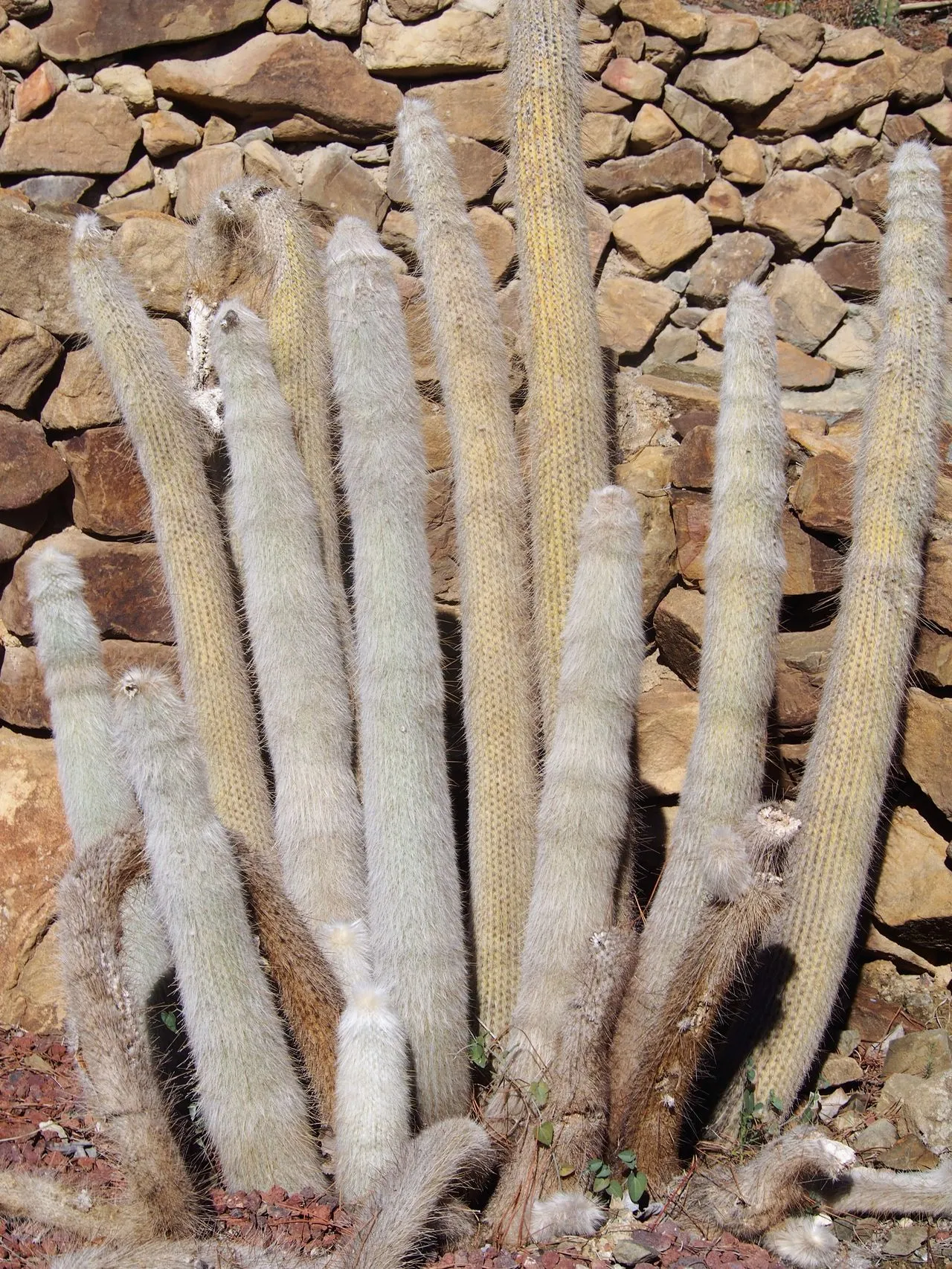
Cleistocactus strausii, originally placed in Pilocereus and treated by Britton and Rose in 1909 before its transfer into Cleistocactus by Curt Backeberg, is the slender columnar cactus that growers and field botanists know as the silver torch. Its native range is narrow, covering rocky slopes around Tarija in southern Bolivia and Salta in northern Argentina at elevations between 1,500 and 3,000 m. The defining feature is the dense covering of white, fine, hair-like bristly spines that wraps each column so thoroughly that the green chlorophyll body underneath is barely visible, producing the silver-white outline that gives the species its English common name.
In habitat, the species sits on steep rocky slopes and arid intermontane valleys of the eastern Andes, on stony, free-draining mineral soils derived from sandstone and conglomerate, where summer rain falls in short bursts and winter nights regularly drop below zero. The 1,500 to 3,000 m elevation range matters for cultivation: it explains both the species' tolerance of strong light and its unusual cold hardiness for a cactus from a subtropical latitude. Conservation status on the IUCN Red List is Least Concern, with stable populations across both the Bolivian and Argentine sub-ranges. The species is widely propagated in cultivation, so wild collection pressure is negligible and most plants in the trade are nursery-grown from seed.
Part of the Complete Cactus Guide.
Identification
A mature C. strausii in habitat or in a generous outdoor pot is a slim, upright column 1.5 to 3 m tall, occasionally reaching 4 m on long-grown specimens, and 6 to 8 cm in diameter. The proportions are the first identifier: a stem this narrow yet this tall is unusual among the columnar cacti commonly sold under "torch" or "candle" labels. Branching is basal rather than apical. Mature plants throw new columns from near ground level, building a clump of parallel torches over decades rather than a tree-like candelabra.
The areoles are tightly packed along low ribs, and each carries 30 or more thin radial spines plus around 4 short, slightly stiffer central spines that are reddish-brown when young and fade with age. The radials are not stout pricks but fine bristles, and they cover the column so densely that the body looks white from a distance and only reveals patches of green when wind disturbs the bristly coat. Pink to deep pink-red tubular flowers, 5 to 9 cm long, emerge from upper areoles in summer on mature plants. The species does not flower as a juvenile; specimens generally start producing buds 8 to 15 years from seed, often at a column height of about 1 m, and once they begin they tend to flower annually.
The lookalikes worth knowing apart:
- Cereus peruvianus (correctly C. repandus) lacks the white-bristle covering entirely; its blue-green ribbed body is fully visible, columns are 12 to 20 cm wide, and it grows into a tree-sized candelabra rather than a slim clumping column.
- Carnegiea gigantea, the saguaro, is a much larger plant with a thick fluted trunk over 30 cm in diameter at maturity and stout straight spines on an exposed green body, never the dense white bristly coat.
- Espostoa lanata, the Peruvian old man cactus, shares a similarly woolly silver appearance but its columns are noticeably broader (typically 8 to 15 cm), the ribs more pronounced, and the surface clad in soft cottony wool rather than the fine wiry bristles of C. strausii. Espostoa also forms a lateral cephalium of denser wool from which flowers emerge, a structure absent in Cleistocactus.
Cultivation
Strong direct light is the first requirement. In active growth, C. strausii wants 6 hours or more of direct sun daily; an unshaded south-facing window in temperate latitudes, or full sun outdoors once acclimated over 10 to 14 days, keeps the bristles dense and white. Insufficient light produces a flagged column with thinner bristle cover and visible green tissue between areoles, a clear cosmetic warning that conditions need to change before the apex narrows further.
Watering follows the deep-soak then dry pattern typical of column cacti. In summer, a 15 to 20 cm pot of mineral-heavy substrate housing a 60 cm plant typically dries through in 7 to 12 days at room temperature; soak until water runs from the drainage hole, then wait until a moisture probe in the top 3 cm reads below 15% before the next watering. From late autumn to early spring, when night temperatures sit below 10 °C and light is poor, taper hard. One light watering every 6 to 8 weeks is enough during winter rest, and skipping a session is usually safer than overdoing it.
Substrate should be 70 to 80% mineral material (pumice, lava rock, coarse grit at 3 to 6 mm) and 20 to 30% low-peat compost. The high mineral fraction matters more here than for many cacti because C. strausii tolerates cool, damp winter conditions worse than several rot-prone column relatives; a free-draining mix lets the substrate dry quickly even after an overcast week. Pot in unglazed terracotta where possible, in a pot only one size larger than the root ball. A 60 cm column does not need a 30 cm pot, and the slim aboveground form sits stably in a smaller, heavier pot than its height suggests.
Temperature tolerance is one of the species' selling points. Mature, dry plants survive short exposures down to about -7 °C without permanent damage, a high-elevation legacy from its 1,500 to 3,000 m native range. Treat that as brief, dry, emergency tolerance, not a target. Aim to keep winter minimums above 5 °C if you can, and never allow the plant to be cold and wet at the same time; freezing wet substrate ruptures roots and causes rot that only becomes visible months later when the apex blackens. Summer maximums of 35 to 40 °C are tolerated without obvious stress provided airflow is good and roots are healthy.
Propagation
Seed is the primary propagation method for C. strausii because the species is reluctant to branch from the apex and basal offsets are slow to detach cleanly. Fresh seed germinates in 10 to 21 days at 22 to 28 °C on a sterile fine mineral mix kept under high humidity. Seedlings are slow for the first year, reaching only 2 to 3 cm in their first growing season, but they accelerate noticeably from year two and typically reach 15 to 20 cm by the end of the third year under good light. Two genetically distinct flowering plants are needed for reliable seed set, since self-pollination success is low.
Stem cuttings work but ask for patience. Cut a basal offset or a column section 15 to 25 cm long with a clean blade, callus the cut surface in a shaded, dry, airy position for 2 to 3 weeks until it is pale and sealed, then insert upright into dry mineral substrate. Light watering can begin once new roots anchor the cutting, usually 4 to 8 weeks at 22 to 28 °C. Apical cuttings root more reliably than basal sections, but they leave the parent plant blunt and slow to recover, so most growers cut basal offsets once the parent has produced them and accept the slower rooting in exchange for keeping the original column intact.
Grafting onto fast-growing stocks (Hylocereus or Trichocereus) is occasionally used to push juvenile growth in nurseries; the scion can reach a flowering-sized column in 4 to 6 years rather than 8 to 15. Grafted plants often show slightly different bristle texture and column proportion from own-root specimens, and the union eventually fails after a decade or two, so most collectors prefer slower own-root plants for long-term keeping.
Notes
In trade, the silver torch is sometimes confused on labels with Cleistocactus winteri (a pendant, golden-spined relative usually grown in hanging baskets) and with Espostoa lanata. The most reliable separator from Espostoa in a nursery setting is column diameter: a stem under 8 cm wide with fine hair-like bristly cover is almost always C. strausii, and a stem over 8 cm wide with softer cottony wool is almost always Espostoa. Crested forms of C. strausii are circulated in collector channels, usually as grafted specimens, and they retain the dense white bristle cover on their twisted, fan-shaped growth, which makes them visually distinctive but no harder to grow than the straight species.
The plant is not toxic, and the bristly spines, while dense, are flexible and rarely puncture skin during casual contact. Cats and dogs typically leave it alone after one investigation. Common pests are the same as for other slim column cacti: mealybug colonies hide deep among the bristles where they are difficult to spot until populations are large, so monthly inspection with a hand lens at the column base and apex is worthwhile, especially in indoor winter quarters.
See also
- The Complete Cactus Guide, broader Cactaceae context and care fundamentals
- Beginner's Guide to Succulents, foundations for first-time growers
- Cereus peruvianus, the much larger blue-green columnar relative
- Carnegiea gigantea, the iconic saguaro of the Sonoran Desert
Frequently Asked Questions
What is the common name of Cleistocactus strausii?
It is commonly called silver torch cactus because white hair-like spines cover the vertical stems.
Where does Cleistocactus come from?
The genus includes slender columnar species from Bolivia, Argentina, Uruguay, and Peru.
Do Cleistocactus flowers open fully?
Often no. The tubular flowers commonly remain narrow rather than opening widely, which is normal for the genus.
What winter care does silver torch need?
Strong light and a cool dry winter rest suit the species, with watering reduced while temperatures are low.