| Question | Short Answer |
|---|---|
| How fast does a saguaro grow? | Very slowly. |
| Where is Carnegiea gigantea native? | It is native to the Sonoran Desert of Arizona, Sonora, and adjacent areas. |
| How tall can a mature saguaro get? | Mature saguaros can reach 12 m to 18 m in habitat and may live for well over 150 years. |
| Is saguaro a practical houseplant? | It is more a symbol than a practical houseplant. |
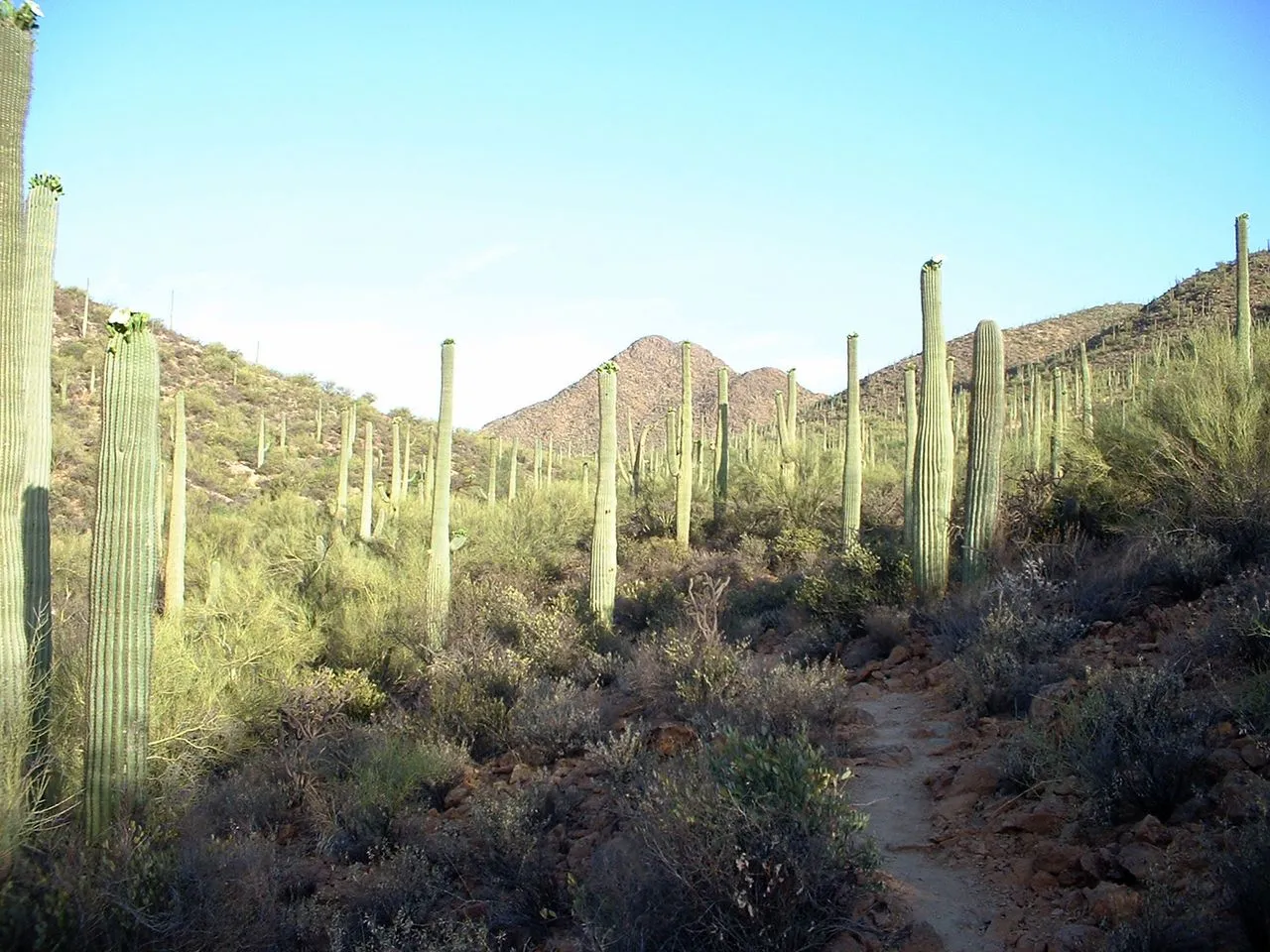
Carnegiea gigantea (Engelm.) Britton & Rose was placed in its current monotypic genus in 1908, after George Engelmann had originally described the plant in 1848 as Cereus giganteus from material collected in the borderlands of what is now southern Arizona. The species is endemic to the Sonoran Desert, with a core range across southern and central Arizona, the Mexican state of Sonora, and a small western foothold in the desert valleys of southeastern California along the lower Colorado River. It grows on rocky bajadas, gravelly slopes, and open creosote flats between roughly 200 and 1,500 m elevation. The defining feature is its scale: a mature saguaro is a massive ribbed column, 25 to 50 cm in diameter, frequently 12 to 18 m tall and occasionally reaching 20 m or more, with arms that finally appear after seven to ten decades of life.
In habitat the plant is the architectural backbone of the Arizona Upland subdivision of the Sonoran Desert. Young seedlings rely almost entirely on "nurse plants", typically Parkinsonia microphylla (foothill palo verde) or Olneya tesota (ironwood), whose canopies buffer summer ground temperatures and shelter the cactus from winter radiative cooling. Soils are coarse, gravelly, and often calcareous, and successful recruitment cohorts can be decades apart. Lifespan ranges from about 150 to 250 years for plants that escape lightning, frost, and toppling. International trade is regulated under CITES Appendix II, and within Arizona the species is also protected under the state's Native Plant Law, which requires permits and tags for any movement. Saguaro National Park, established near Tucson in 1933, protects representative stands; wild collection on federal land carries criminal penalties.
Part of the Complete Cactus Guide.
Identification
The body of C. gigantea is a single thick, vertical green column with 12 to 25 ribs that run from base to apex. Each areole carries roughly 25 stiff radial spines and several heavier centrals, short and bristly compared with the dramatic hooks of Ferocactus. New growth at the crown is paler and slightly twisted, settling into the standard rib geometry as it ages.
Arms develop late. A 4 m specimen with no branches is still a juvenile by saguaro standards: the first arm typically appears between 70 and 100 years of age, and a multi-armed silhouette implies a plant of 125 years or more. Growth is slow at every stage. Cultivated juveniles add only 2 to 3 cm of height per year, climbing to 5 to 10 cm per year once mature and well rooted. Flowers open at the apex of the trunk and on the crowns of arms from late April into early June, 7 to 8 cm across, white with cream stamens, opening at night and remaining open into the following morning. The species' bloom is the Arizona state flower. Fruits ripen in early summer to a fleshy red-pink, splitting open to expose seed-laden crimson pulp.
Lookalikes. Pachycereus pringlei, the Mexican giant cactus or cardón, replaces C. gigantea further south through Baja California and coastal Sonora; it reaches similar or greater heights, but carries more numerous ribs, branches lower on the trunk, and shows a heavier, more woolly areole. Stenocereus thurberi, the organ pipe cactus, is a different growth form: instead of one massive trunk that may eventually arm, S. thurberi branches from at or near ground level into a candelabra of slender 10 to 20 cm columns. If you see a single thick column carrying its first arms well above head height, you are looking at saguaro, not organ pipe.
Cultivation
Light. C. gigantea needs the strongest light a grower can supply. Habitat photosynthetic photon flux densities at the crown commonly exceed 1,500 µmol/m²/s during the summer day, and even mature plants in cultivation pale and etiolate under typical glasshouse shading. Outdoor full sun in arid Mediterranean and warm-temperate climates is appropriate after a 14 to 21 day acclimation; indoor cultivation past a single juvenile year is rarely viable.
Water. From late spring through early autumn, water deeply and let the substrate dry through the full pot before the next soak; in a 25 cm pot this is usually 14 to 28 days. Withhold water entirely from late autumn through early spring, when night temperatures drop below about 10°C.
Substrate. Use a strongly mineral mix at roughly 80% mineral material to 20% loam-based compost. A workable recipe: 40% pumice, 30% coarse grit at 3 to 6 mm, 10% lava or crushed granite, and 20% loam compost.
Temperature. Active growth runs from about 18 to 38°C. In habitat, winter overnight lows occasionally touch about -7°C for a few hours; sustained freezes kill apical and vascular tissue, as the documented die-back of saguaros around the 1937 and 1962 Arizona hard freezes shows. In cultivation, treat -2°C as the realistic floor for short, dry exposure on mature plants; juveniles below 50 cm should not be exposed to frost.
Cultivation limits
The honest answer is that C. gigantea is not a sensible long-term houseplant or temperate-garden subject. Five constraints converge.
- Mature size. A 12 to 18 m plant with arms cannot be accommodated in any conventional collection. A grower who keeps a saguaro for fifty years will have nursed it from a 5 cm seedling to roughly 1 to 3 m, far short of adult character.
- Frost. Outside USDA zones 9b and warmer, winter cold either kills the plant outright or imposes annual heated-greenhouse storage. The combination of cold and wet roots is rapidly fatal.
- Light. Without intense, direct sun for at least six hours a day across the growing season, new growth narrows, rib structure becomes irregular, and the plant accumulates rot-prone soft tissue.
- Bacterial soft rot. Humid air, overhead water, and any wound or freeze damage open the door to Erwinia-type bacterial necrosis. In Arizona collections this is the main cause of cultivated death; affected sections turn black, ooze, and collapse within weeks.
- Legal protection. Wild collection in Arizona is a criminal offence, and any cross-border movement is regulated under CITES Appendix II. Reputable nurseries sell only nursery-grown seedlings or salvaged plants with state tags. If a plant offered at a sale lacks documentation, walk away.
Outside Sonoran-climate regions, treat C. gigantea as a juvenile-only project: a 30 cm plant in a deep terracotta pot, kept frost-free and in full sun, is achievable. A real adult saguaro in the garden is a plant for residents of Tucson, Phoenix, or comparable climates.
Propagation
Seed is the only routine method. Fresh seed germinates on a sterile fine mineral surface at 26 to 30°C, with bright filtered light and a covered tray to hold humidity. Expect emergence in 7 to 21 days, with germination rates of 60 to 80% from cultivated stock. Growth is the bottleneck: a one-year seedling is 5 to 10 mm across, a five-year plant 3 to 6 cm, and a saleable 30 cm specimen typically represents 8 to 12 growing seasons of careful work. Vegetative propagation from arm cuttings is technically possible on damaged adult plants, but it is not a routine method.
Notes
Ecological role. Saguaros support a dense web of desert wildlife. Gila woodpeckers and gilded flickers excavate cavities that, after the inner tissue lignifies into a hard "boot", are reused by elf owls, screech owls, and purple martins. Lesser long-nosed bats are the principal night pollinators, and the fruit harvest, locally called bahidaj, remains a central seasonal event for the Tohono O'odham nation, who continue traditional harvests in Saguaro National Park under formal agreement.
Trade and legality. Beyond Arizona's Native Plant Law and CITES Appendix II, both Mexico and the United States restrict export and interstate movement of wild specimens. Buy only nursery-grown seedlings with documentation.
Pests and handling. Mature trunks are heavy and top-loaded; spines are stiff enough to draw blood through a leather glove, so use foam blocks and a strap, not a hand grip. Watch for cochineal scale on shaded flanks and act within days on the first dark, glistening lesion that signals soft rot.
See also
- The Complete Cactus Guide, the broader cultivation guide covering ribs, mineral substrate, frost protection, and light.
- Ferocactus wislizeni, the fishhook barrel of the same Sonoran desert, useful for comparing rib structure and adult proportions in a more cultivable species.
- Opuntia basilaris, the beavertail prickly pear, a fellow Sonoran species that is genuinely tractable in a temperate garden.
- A Beginner's Guide to Succulents, broader context for matching cacti to light, substrate, and seasonal water.
Frequently Asked Questions
How fast does a saguaro grow?
Very slowly. The pillar notes that a 10-year-old seedling may still be only a few centimetres tall.
Where is Carnegiea gigantea native?
It is native to the Sonoran Desert of Arizona, Sonora, and adjacent areas.
How tall can a mature saguaro get?
Mature saguaros can reach 12 m to 18 m in habitat and may live for well over 150 years.
Is saguaro a practical houseplant?
It is more a symbol than a practical houseplant. Seedlings can be grown in pots, but mature size and time scale put the adult plant beyond indoor culture.