| Question | Short Answer |
|---|---|
| Why is Echeveria 'Black Prince' turning green? | Low light causes the rosette to revert to bronze-green and loosen. |
| How large does Echeveria 'Black Prince' grow? | A typical mature rosette is 7 to 10 cm across with broadly triangular 4 to 6 cm leaves. |
| Can Echeveria 'Black Prince' grow from seed? | No. |
| Is Echeveria 'Black Prince' frost hardy? | Only moderately. |
Echeveria 'Black Prince' is a hybrid cultivar bred by Frank Reinelt in California in the mid-twentieth century from a cross of Echeveria shaviana x Echeveria affinis. It is not a wild species and has no natural population. The plant forms a compact stemless rosette 7 to 10 cm wide, with broadly triangular leaves 4 to 6 cm long, that darken from green-bronze to a near-black purple under bright light. The dark colour is the diagnostic character, inherited from E. affinis, and is the reason the plant is grown.
Hybrid origin
Reinelt was a Czech-born plant breeder based in Capitola, California, best known for his work on Crassulaceae and tuberous begonias from the 1930s through the 1950s. 'Black Prince' is one of his named Echeveria selections from that era. The published cross is E. shaviana x E. affinis, both Mexican species: E. shaviana contributes the broader leaf outline and the cool, slightly bluish base tone; E. affinis contributes the very dark, near-black anthocyanin pigment that gives 'Black Prince' its name. Because the cultivar is of hybrid parentage, every plant in the trade descends from Reinelt's original line by vegetative propagation. Seed-grown offspring segregate so widely that none come true to the type, and any plant labelled 'Black Prince' that was raised from seed is not the cultivar. Tissue-culture stock is now common in commercial production, and visible drift over generations means the rosette sold as 'Black Prince' at one nursery is not always quite the same as the rosette sold under that label at another.
Part of the Complete Echeveria Guide.
Identification
A typical 'Black Prince' rosette in cultivation runs 7 to 10 cm across, sits stemless or on a very short stem, and holds its leaves in a tight, slightly cupped arrangement. The leaves are broadly triangular, 4 to 6 cm long, thick and softly fleshy, and finish in a sharp terminal mucro. The colour shifts strongly with light. In moderate growth the rosette reads bronze-green with a chocolate cast at the leaf tips. Under four to six hours of direct sun and cool nights, the bronze deepens through dark purple-brown to nearly black, with the inner leaves often the darkest and the outer leaves a touch greener. In low light the colour reverts: the rosette flattens out, the leaves loosen, and the plant returns to a uniform green-bronze with the dark colour washed out entirely. The reversion is a useful diagnostic; if the plant cannot turn dark at all under bright sun, it is unlikely to be the cultivar.
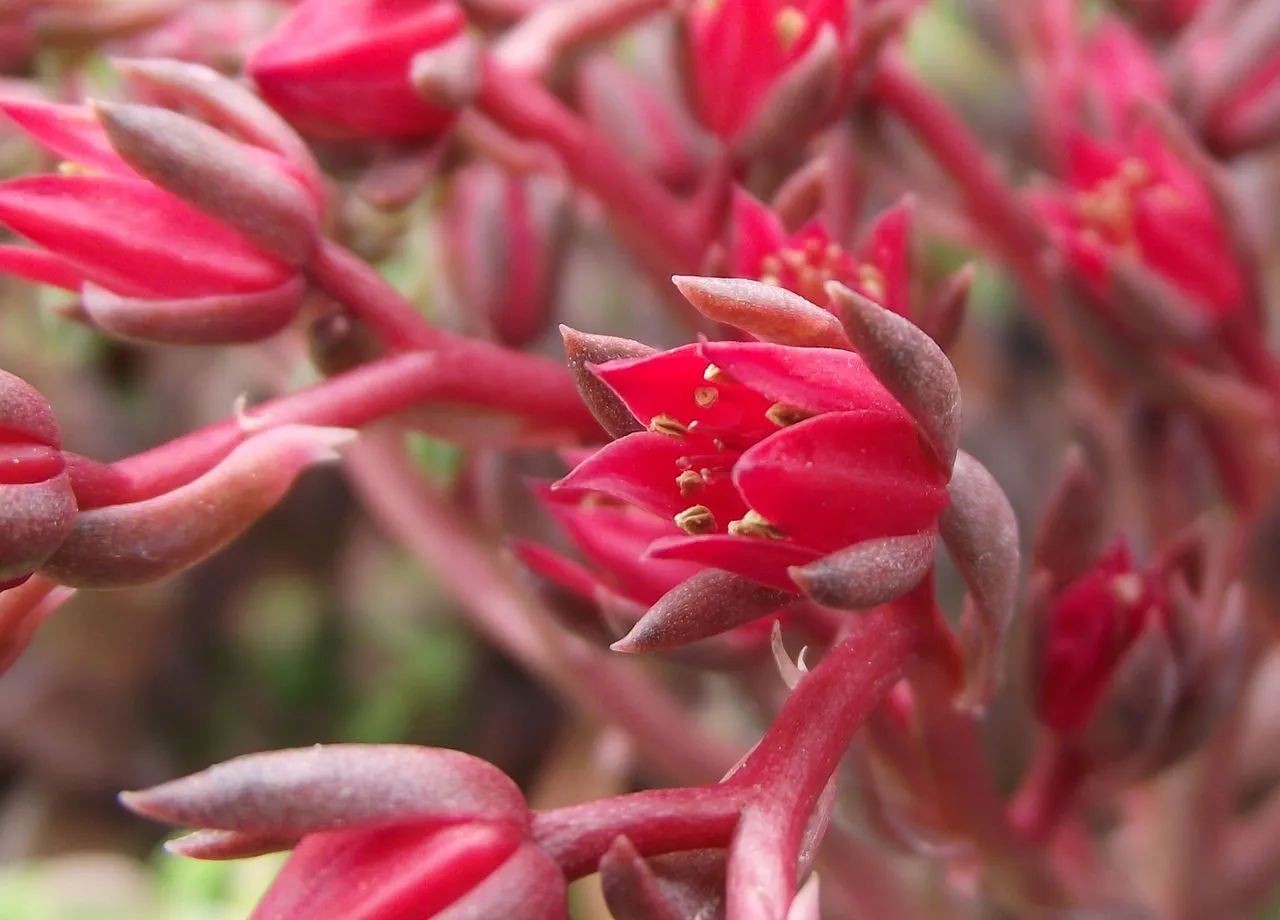
Growth is slow. A leaf cutting takes 8 to 12 months to reach a 4 cm rosette, and a mature plant produces only 1 to 3 offsets a year. Flowering is autumn-to-winter rather than spring, and the scape is taller than most small Echeveria: a 25 to 40 cm spike of bright red-orange bell-shaped flowers, larger and more saturated than the bicoloured flowers of E. derenbergii hybrids. The colour and timing of the inflorescence is a quick second confirmation alongside leaf colour.
Four lookalikes account for almost all the confusion in the trade. Echeveria 'Black Knight' shares the dark colour and is the closest match, but its leaves are noticeably narrower and more lanceolate, and the rosette carries a heavier silvery wax bloom that 'Black Prince' lacks. Echeveria 'Onyx' also goes nearly black, but its leaves are visibly glossier with very little farinose coating, and the rosette tends to be larger and looser than 'Black Prince'. The two parent species are simpler. Pure E. affinis darkens to a deeper, more uniform black than the hybrid, but its leaves are smaller and more sharply pointed, and its rosette is looser. Pure E. shaviana never goes black at all: it stays a frosty blue-green and carries pronounced frilly, wavy leaf margins that 'Black Prince' does not have. Set 'Black Prince' next to either parent and the hybrid sits clearly between them in size, in colour, and in leaf outline.
Cultivation
Light is the lever for the colour the plant is grown for. Four to six hours of direct sun, after a careful spring acclimation, holds the rosette tight and brings the dark purple-black to its full intensity. A south or southeast aspect outdoors in temperate climates suits it; indoors, an unobstructed south or east window is the working setup. Under fluorescent light or a north-facing room the plant runs green-bronze and the dark colour never develops. The reversion is reversible: a 'Black Prince' kept indoors over winter and put back into bright light in spring will redarken over 4 to 8 weeks, though slowly, in step with the cultivar's general slow growth.
Water is conventional for the genus. Water deeply once the top 3 cm of substrate reads dry, and water the substrate around the rosette rather than the leaves themselves; the leaf surface is not as waxy as a 'Lola' or a 'Perle von Nürnberg', but standing water in the crown still invites rot. In warm growth that is roughly every 10 to 14 days for a 9 cm pot at 22 °C to 28 °C. In winter, drop to a single light watering every 4 to 6 weeks, or hold dry below 8 °C.
Substrate runs at 65% to 75% mineral fraction. Pumice or 3 to 6 mm lava grit with a peat-free loam-based compost as the organic component is the working blend. The pot should dry inside a 48 hour window after a thorough watering. A 9 to 11 cm terracotta pot suits a single mature rosette; the slow growth rate means a repot every 2 to 3 years is enough.
Temperature tolerance is moderate. Active growth runs from 8 °C to 28 °C. The frost limit on dry plants is around minus 2 °C; below that, leaf-tip damage and crown rot are likely. 'Black Prince' is therefore not a candidate for unprotected outdoor culture in regions where winter night temperatures drop below freezing. Bring it under cover or indoors before the first frost. In summer above 32 °C, give afternoon shade and ventilation; the dark leaves heat up faster than pale-leafed Echeveria in full midday sun and can scorch on a stagnant southwest balcony.
For a baseline watering and feeding rhythm before tuning to this cultivar, the beginner's guide to succulents sets out the method that the notes above adapt to 'Black Prince'.
Propagation
Vegetative propagation is the only acceptable method for keeping 'Black Prince' true. Three vegetative routes work, in this order of reliability.
Offset division is the cleanest. The plant offsets sparingly, so plan on 1 to 3 rooted offsets per mature rosette per year. Once an offset is rooted and a third the width of the parent, twist or cut it free, callus the wound for 5 to 7 days in shade, and resume light watering after about two weeks on dry mineral mix. Success runs above 90% on rooted offsets.
Leaf propagation works but is markedly slower than for fast-leafing Echeveria such as E. elegans or E. derenbergii. A clean sideways twist is required. Callus the leaf for 5 to 7 days, set on barely damp pumice in bright shade at 21 °C to 25 °C, and expect a plantlet within 6 to 10 weeks at a success rate of around 50% to 70%. The young plant takes 8 to 12 months to reach a 4 cm rosette; plan on a longer wait than with most genus standards.
Stem cuttings from older, drawn plants are the third route. If a 'Black Prince' has been kept in low light and has put out a stem with a lifted rosette, decapitate the rosette, callus the cut for 7 to 10 days, and root the head on dry mix. The stub usually sends out a flush of new offsets at the cut site within 6 to 10 weeks. This is the standard method for resetting a stretched plant and a useful way to multiply slow stock.
Seed is not a viable route. As a wide hybrid between two parent species, 'Black Prince' does not come true from seed; the offspring segregate so widely that none reliably resemble the named clone. Anyone selling Echeveria 'Black Prince' seeds is selling a mislabelled product or a random Echeveria outcross.
Notes
Provenance matters in the trade. The reliable separators for a true 'Black Prince' are the broadly triangular leaves with a sharp terminal mucro, the strong reversion to green under low light, and the autumn-winter scape of red-orange flowers rather than spring bicoloured flowers. A rosette that stays dark under poor light, or whose leaves are narrow and silver-bloomed, is more likely 'Black Knight'; a glossy, larger near-black plant with little farinose coating is more likely 'Onyx'. Tissue-culture lines circulating since the 2000s have introduced visible drift; if you want a clean reference clone, look for cuttings from an established grower with a known provenance line back to Reinelt's original material.
Pests are conventional for the genus. Mealybugs hide in the dense crown and at offset bases and need a check every season; a 70% isopropyl alcohol swab on a cotton bud at the affected sites clears them without staining the leaves. Aphids appear on the autumn scape and clear with a soft hose rinse. 'Black Prince' is not toxic to humans, dogs, or cats in any meaningful sense.
See also
- Complete Echeveria Guide — genus-level substrate, light, and propagation principles.
- Echeveria 'Perle von Nürnberg' — a larger bronze-purple hybrid often shelved next to 'Black Prince' in shops.
- Echeveria runyonii — a Mexican species with a comparable compact rosette but a pale silver-blue rather than dark colour.
Frequently Asked Questions
Why is Echeveria 'Black Prince' turning green?
Low light causes the rosette to revert to bronze-green and loosen. Move it gradually into four to six hours of direct sun and colour returns over 4 to 8 weeks.
How large does Echeveria 'Black Prince' grow?
A typical mature rosette is 7 to 10 cm across with broadly triangular 4 to 6 cm leaves. Growth is slow compared with many common echeverias.
Can Echeveria 'Black Prince' grow from seed?
No. The cultivar is a hybrid clone and seed-grown offspring do not come true to type. Use offsets, leaves, or stem cuttings.
Is Echeveria 'Black Prince' frost hardy?
Only moderately. Dry plants may tolerate about −2 °C with damage, but wet cold causes leaf-tip damage and crown rot.