| Question | Short Answer |
|---|---|
| How is Echeveria harmsii different from Echeveria setosa? | E. |
| How tall does Echeveria harmsii grow? | Mature plants stand about 20 to 40 cm tall, with woody lower stems and a candelabra-like crown of small rosettes. |
| What is the best way to propagate Echeveria harmsii? | Stem cuttings are most reliable. |
| Can Echeveria harmsii leaves be propagated? | Yes, but leaf propagation is less dependable than stem cuttings. |
Echeveria harmsii J.F.Macbride, the plush plant, was first described in 1922 as Oliveranthus harmsii by James Francis Macbride and transferred to Echeveria by Eric Walther in 1934. The species is native to dry hillsides in Oaxaca, Mexico, at 1,500 m to 2,200 m, and stands apart from most echeverias in three ways: a tall branching shrubby habit reaching 20 to 40 cm, narrow leaves covered in fine velvet hairs, and unusually large bicolour flowers.
In habitat, E. harmsii grows on rocky slopes with thin mineral soil, full sun for most of the day, and a marked seasonal swing between summer rain pulses and a long dry winter. Those origins explain why the cultivated plant prefers a lean substrate, a real winter rest, and very bright light. It is not a humidity-loving rosette plant, and the soft, slightly fluffy leaves are an adaptation to high-altitude radiation rather than a request for shade.
Part of the Complete Echeveria Guide.
Identification
The form is the first clue. Most echeverias commonly seen in cultivation are stemless or short-stemmed rosettes that sit close to the substrate. E. harmsii is a true branching shrublet. Mature plants make woody lower stems and a candelabra-like crown of small terminal rosettes, the whole plant standing 20 to 40 cm tall. A large container specimen can resemble a miniature shrub more than a typical succulent rosette.
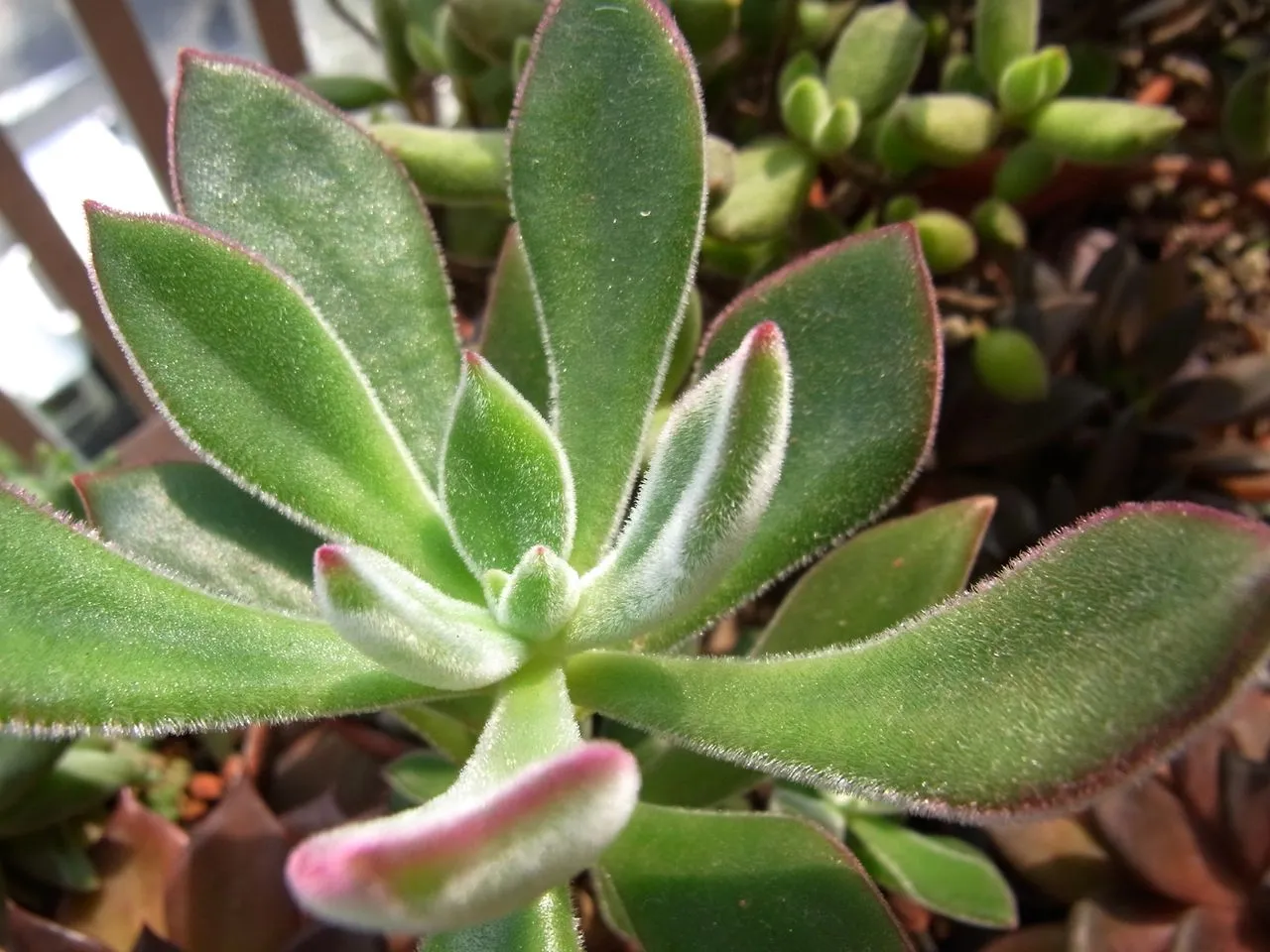
Each rosette is small and narrow, usually 5 to 7 cm across, made up of around 20 to 30 lance-shaped leaves 3 to 5 cm long. The leaves are covered with dense, fine, soft hairs (pubescence), giving a matte velvet feel. This is the source of the common name plush plant. In bright light, the olive-green leaves flush red-orange along the margins and tips, with the colour deepening through cool dry winters.
Flowering is the second diagnostic feature. From a 15 to 25 cm scape in spring, plants carry bell-shaped, bright red flowers 2 to 3 cm long with yellow tips, often described as bicolour. Most Echeveria produce small flowers around 0.8 to 1.5 cm long, so a rosette opening 2 to 3 cm scarlet-and-yellow bells is rarely anything else. The combination of a shrubby habit, fuzzy narrow leaves, and very large bicolour flowers separates E. harmsii from almost every other species in cultivation.
Three lookalikes deserve careful attention.
Echeveria setosa is also pubescent, but the hairs are different. They are stiffer, white, and bristle-like (setose, not the fine soft fur of E. harmsii), and the rosettes are stemless or short-stemmed and densely crowded rather than terminal on woody branches. Flowers of E. setosa are smaller, in the typical genus range. If the hairs feel like coarse white whiskers and the plant sits flat on the substrate, it is E. setosa, not E. harmsii.
Echeveria pulidonis is glabrous, with smooth, paddle-shaped, glaucous green leaves edged in red. There are no hairs at all. A plant with smooth leaves cannot be E. harmsii whatever the label says.
Echeveria nodulosa shares a tall, somewhat shrubby habit with E. harmsii and can be confused at a casual glance. The differences are surface and pattern. E. nodulosa leaves are smooth or only minutely papillate, with painted markings (red lines along the midrib and margins), and the rosettes carry broader, keeled leaves rather than narrow lanceolate ones. No fine hair, and you will see lines rather than a uniform velvet flush.
Cultivation
If echeverias are new to you, the beginners guide covers the underlying watering and substrate logic; the species adjustments below assume that baseline.
E. harmsii tolerates more sun than the average highland echeveria and rewards it with compact internodes and saturated leaf colour. Outdoors in temperate climates, give 4 to 6 hours of direct sun a day, with light afternoon shade only when summer temperatures exceed 32 °C. Indoors, a south-facing window is usually the minimum for compact growth; an east window will keep the plant alive but stems will lengthen and lower leaves will drop.
Watering follows the genus pattern with one structural caveat. The branching habit means stems harvest water poorly compared to the dense rosettes of E. elegans or E. setosa; old wood is slow to take up moisture, and overwatering tends to rot the lower stem rather than the crown. In active spring and summer growth, water deeply when the top 3 to 4 cm of substrate is dry and the lowest leaves on each rosette have lost faint firmness. In a 12 cm terracotta pot, that is roughly every 7 to 14 days in warm weather. In winter, water once a month or less, and keep the lower stem dry. The fine hairs hold droplets, so apply water at the substrate surface, not over the foliage.
Substrate should be very mineral. A working mix is 65% to 75% pumice, lava grit, or coarse perlite, with the remainder a peat-free loam-based compost. The shrubby form sits top-heavy as it ages, so a heavier mineral fraction also helps the pot stay upright. Repot every 2 to 3 years, refreshing the upper third of the substrate without disturbing the woody base unless rot is suspected.
Temperature tolerance is moderate. Steady growth happens between 8 °C and 30 °C. Dry, established plants will accept brief dips to about -2 °C without damage, especially if the substrate has been bone-dry for several weeks; wet plants near freezing show the usual symptoms of translucent collapsed leaf areas and a blackened lower stem. I treat 0 °C as the practical minimum in an unheated greenhouse and bring plants in at -3 °C forecasts regardless of substrate condition.
Pot size matters more than for typical rosette echeverias. A young single-stem plant grows well in a 9 cm pot. A multi-stem branching specimen takes a 12 to 15 cm pot, and a mature shrub can fill an 18 to 20 cm pot. Terracotta is preferable: it shortens the wet period after watering and adds weight against tipping.
Propagation
The branching shrubby habit changes the propagation calculus compared with stemless echeverias. Stem cuttings are the most reliable method, not leaf or offset, and the species is among the easier echeverias to propagate this way once you understand the timing.
Take stem cuttings in late spring or early summer when active growth resumes. Cut a terminal segment 5 to 8 cm long with a clean blade, ideally below a node where the wood begins to harden. Strip the lowest two or three leaves to expose a clean stem, then callus the cut for 7 to 10 days in dry shade. Plant the cutting upright in dry mineral mix at 22 °C to 26 °C, support it lightly with a small stake if it leans, and begin light watering once the cutting resists a gentle tug. Roots usually appear within 2 to 4 weeks, and a new shoot pushes from a leaf axil within 6 to 8 weeks. Success rates above 80% are reasonable to expect.
Leaf propagation is possible but less dependable than with glabrous echeverias. The fine pubescence holds moisture at the leaf base after detachment, so rot competes with rooting. Twist a healthy mature leaf sideways at the node, callus for 5 to 7 days, and lay it on barely damp pumice in bright shade at 21 °C to 24 °C. Expect roughly 30% to 50% success and a longer time to plantlet (8 to 12 weeks for a usable rosette) compared with E. elegans or E. pulidonis.
Offset division is occasional. Mature plants sometimes produce basal offsets from the woody base; remove them with a small piece of stem when they reach 2 to 3 cm and treat as a stem cutting. Seed is rarely useful in the home: the species is not reliably self-fertile, and any garden seedlings will likely be hybrids if other echeverias flower nearby.
Notes
Mealybugs hide in the velvet pubescence, the same problem as on E. setosa but worse along the woody stems where waxy mealybug colonies blend with the bark. Inspect the leaf axils and lower stem with a hand lens monthly, especially after flowering. A cotton swab dipped in 70% isopropyl alcohol clears small infestations without wetting the leaves.
The plush plant circulates as several named selections in trade. 'Ruby Slippers' is a deeper-red, more compact form often rooted from cuttings of strongly coloured stock; it is still E. harmsii, selected for habit and colour. Older books and labels may still list the plant as Oliveranthus harmsii, and a few European nurseries continue to use that name. They refer to the same species; Walther's 1934 transfer to Echeveria is the accepted treatment in modern floras and Plants of the World Online.
If your plant stretches and the lower stem yellows, light is the cause, not water. If a strong, healthy plant collapses at the base over winter, check first whether water sat in the lower stem during a cold week. E. harmsii is not a difficult species, but it punishes the same watering routine that suits its rosette-only relatives. Treat it as a small succulent shrub rather than a fat-leaved cushion, and it will perform for years.
See also
- Complete Echeveria Guide — genus-level light, substrate, and propagation principles.
- Echeveria pulidonis — a glabrous, red-margined sibling that shows the smooth-leaf alternative.
- Echeveria setosa — the bristly Mexican Firecracker that contrasts with the soft velvet of E. harmsii.
Frequently Asked Questions
How is Echeveria harmsii different from Echeveria setosa?
E. harmsii has soft velvet hairs on terminal rosettes carried by woody branches. E. setosa is lower, denser, and has stiffer white bristles.
How tall does Echeveria harmsii grow?
Mature plants stand about 20 to 40 cm tall, with woody lower stems and a candelabra-like crown of small rosettes.
What is the best way to propagate Echeveria harmsii?
Stem cuttings are most reliable. A 5 to 8 cm terminal cutting usually roots in 2 to 4 weeks after callusing.
Can Echeveria harmsii leaves be propagated?
Yes, but leaf propagation is less dependable than stem cuttings. The pubescent leaf bases rot easily and success is roughly 30 to 50 percent.