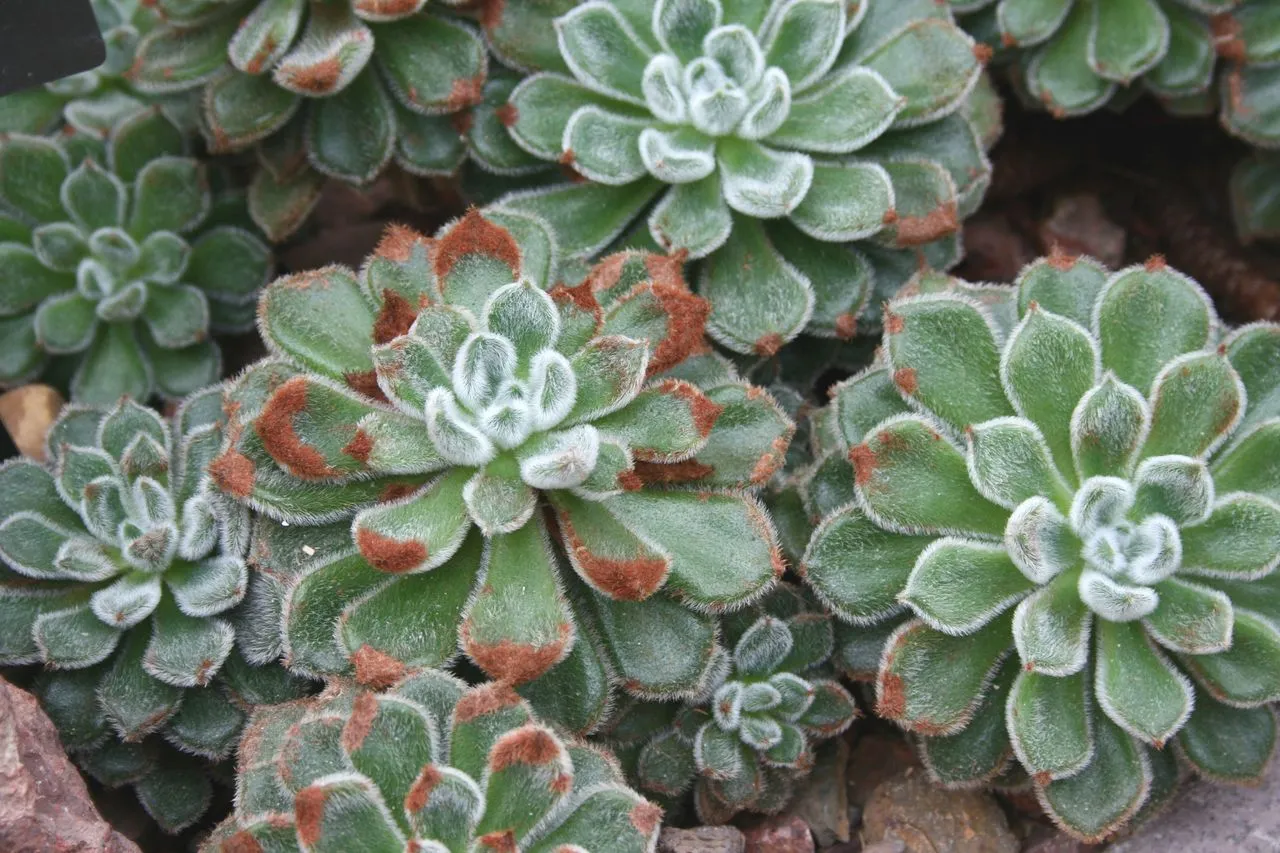
Echeveria setosa Rose & Purpus, the Mexican Firecracker, was described in 1910 from southern Mexican material and remains one of the most recognisable hairy species in the genus. It is endemic to Puebla and Oaxaca, usually reported from rocky highland sites around 1,500 m to 2,500 m, and forms dense pubescent rosettes about 10 to 15 cm across.
In habitat, E. setosa grows on exposed rock faces, ledges, and thin mineral soils where summer rain arrives in pulses and winter is cooler and drier. The elevation tells you more than the nickname does: this is not a lowland desert plant. It wants bright light, strong drainage, moving air, and a winter rest rather than constant warmth and wet compost.
Part of the Complete Echeveria Guide.
Identification
The typical plant makes a compact, stemless to short-stemmed rosette with many crowded leaves. Mature rosettes are usually 10 to 15 cm wide in cultivation, though small forms can remain under 7 cm and old plants can build low clumps by offsetting.
Leaves are fleshy, green to blue-green beneath the hairs, obovate to spoon-shaped, and narrowed toward the base. The feature you notice first is the covering of white bristles. These are not a wax bloom and they are not dust. On a well-grown plant they give the whole rosette a soft, frosted, slightly matte appearance, with the leaf edges sometimes looking almost ciliate.
Flowering is far more dramatic than the rosette size suggests. In late spring, healthy plants can produce a tall raceme exceeding 40 cm, with red-tipped yellow tubular flowers held above the foliage. The flower stalk is often the reason for the common name Mexican Firecracker: the buds and open flowers look like small red and yellow sparks above a fuzzy green base.
Trade confusion is common. E. setosa can be sold as a general "hairy echeveria," confused with pubescent hybrids, or mistaken for the famous hybrid 'Doris Taylor'. 'Doris Taylor' is E. setosa x E. derenbergii, not the species. It usually has a rounder, softer, more evenly plush rosette and often lacks the wiry, bristly look of a good typical E. setosa.
Trichomes
The white covering on E. setosa is made of trichomes: single-celled, hair-like outgrowths from the leaf epidermis. They cover both leaf surfaces, not only the margins, and they are the reason this species behaves differently from smooth-leaved echeverias such as E. elegans or E. pulidonis.
Those trichomes probably serve several functions at once. They scatter intense ultraviolet light at high elevation, hold a thin boundary layer of humid air close to the leaf surface, reduce direct abrasion, and make the leaf surface less inviting to small browsing insects. In cultivation, the same features create two practical problems: they trap droplets and they trap dust.
Water should not sit on the leaves. A smooth echeveria may shed an accidental splash if air movement is good, but the hairs of E. setosa hold water against the epidermis. In cool weather, a wet fuzzy rosette can stay damp for hours, which raises the risk of fungal spotting and crown rot. Water the substrate at the edge of the pot. Do not mist the plant, do not shower it as routine cleaning, and do not use overhead irrigation in a greenhouse unless fans dry the foliage quickly.
Leaf-shine sprays are also inappropriate. They mat the hairs, block gas exchange at the surface, and leave residues that are difficult to remove without damaging the trichomes. The leaves are meant to look matte. If a plant looks dull compared with glaucous, farina-coated species, that is normal. It is pubescent, not waxed.
Dust is the nuisance most indoor growers underestimate. The hairs catch fine household dust, peat particles, and mineral grit. A soft photographer's blower or a dry sable brush works better than water. If you must remove a visible spill, use a barely damp fine brush on one leaf at a time and let the plant dry in strong air movement before night.
Four varietal forms circulate in collections. The names are not always used consistently in trade, but they are useful shorthand when comparing plants.
| Form | Usual look in cultivation | Care note |
|---|---|---|
| var. setosa | Typical 10 to 15 cm rosette, dense white bristles on both surfaces | Best general form for beginners |
| var. deminuta | Smaller, tighter rosettes with a compact habit | Use smaller pots and avoid rich compost |
| var. ciliata | More obvious marginal hairs, often a slightly more open rosette | Water especially carefully around leaf edges |
| var. minor | Dwarf form, often under 7 cm across | Over-potting is the usual cause of decline |
Cultivation
Grow E. setosa in very bright light. Outdoors, give morning sun and light afternoon shade in hot climates; indoors, a south or west window is usually needed for compact growth. Four to six hours of direct sun is a useful target. In Mediterranean sun above 32 °C, acclimate plants gradually or the exposed leaf tips can scorch, even with the protective hairs.
Watering is the part that differs most from the genus default. In active spring and early summer growth, water deeply when the top 3 to 4 cm of substrate is dry and the lower leaves have lost a little firmness. In a 9 cm terracotta pot, that may be every 7 to 10 days in warm weather. In winter, many plants need water only every 3 to 5 weeks. Keep the rosette dry in every season.
Use a mineral substrate with 60% to 75% pumice, lava grit, coarse perlite, or 3 to 5 mm gravel. The remaining fraction can be a peat-free loam-based compost. A mix that stays wet for more than 48 hours after watering is too organic for this species in a normal home. The roots are not unusually weak, but the hairy crown gives you less tolerance for slow drying.
Temperature tolerance is moderate for a highland Mexican echeveria. Keep plants between 5 °C and 30 °C for steady growth. Dry, established plants can usually tolerate brief dips close to 0 °C, but wet foliage near freezing is a recipe for damaged tissue. I treat 3 °C as the practical lower limit in an unheated greenhouse unless the forecast is dry and still.
Pot size matters. A single rosette grows well in an 8 to 10 cm pot; a clump can move to 12 cm once offsets press against the rim. Terracotta is helpful because it shortens the wet period after watering. Plastic pots are usable, but only with a very mineral mix and disciplined watering.
Ventilation is not optional. Dense trichomes slow drying at the leaf surface, so still air magnifies every watering mistake. Indoors, leave space around the plant rather than packing it into a humid succulent arrangement. Outdoors under cover, avoid corners where rain splash and stale air meet.
Propagation
Offsets are the reliable method. Wait until an offset is at least one third the diameter of the parent rosette, then remove it with a clean blade and a small piece of stem attached. Let the cut dry for 4 to 7 days in shade, then pot it into dry mineral mix. Begin light watering after roots grip the substrate, usually in 2 to 3 weeks at 20 °C to 24 °C.
Leaf propagation works, but it is less dependable than with glabrous echeverias. Expect roughly 40% to 60% success from cleanly removed mature leaves under good conditions. The problem is not that leaves refuse to root; many do. The problem is that fuzzy leaves hold moisture and fungal spores around the torn base, so rot claims a higher share before a plantlet forms.
For leaf propagation, twist a lower leaf sideways until the entire base detaches. Do not pull upward, which tears the meristematic tissue needed for a new rosette. Callus for 5 to 7 days, then lay the leaf on barely damp pumice in bright shade at 21 °C to 25 °C. Keep the leaf dry from above. Roots can appear in 2 to 4 weeks, with the first rosette following a few weeks later.
Seed is possible but slow and variable. Like most Echeveria, E. setosa is not a good candidate for casual selfing, and seedlings will not preserve a named form unless both parents are controlled and recorded. Use seed only for breeding work or for maintaining documented accessions.
Notes
Mealybugs hide easily on this species because their white wax blends into the trichomes. Inspect the leaf bases and the underside of old leaves with a hand lens, especially after flowering. Aphids often gather on the tall scapes; remove them early with a cotton swab and alcohol rather than blasting the whole plant with water.
The common hybrid 'Doris Taylor' deserves a label check whenever you buy a plant as E. setosa. It is widely propagated, attractive, and often easier to find than the true species. There is nothing wrong with growing it, but it should not be used as a reference for species characters or wild-type form. For the other commonly grown pubescent echeveria with softer velvet hairs, see Echeveria harmsii.
If your plant stretches, it is under-lit. If the centre browns or collapses after watering, the crown stayed wet. If the leaves look grey and dusty rather than evenly white-bristled, clean with dry air or a brush rather than rinsing. Most failures with E. setosa come from treating the trichomes as decoration instead of as a surface that changes water behaviour.
See also
- Complete Echeveria Guide — genus-level light, substrate, and propagation principles.
- Echeveria pulidonis — a smooth, red-edged species that shows the opposite leaf-surface strategy.
- Echeveria 'Perle von Nürnberg' — a glabrous hybrid useful for comparing farina and colour change.
Frequently Asked Questions
What are the white hairs on Echeveria setosa?
They are trichomes, hair-like leaf outgrowths that scatter light and change how water behaves on the leaf surface.
Can Echeveria setosa leaves get wet?
Avoid it. The hairs hold droplets against the epidermis, raising the risk of fungal spotting and crown rot in cool weather.
How do you propagate Echeveria setosa?
Offsets are the most reliable method. Leaf propagation works at roughly 40 to 60 percent but fuzzy leaf bases rot more easily.
Is Echeveria setosa the same as Doris Taylor?
No. 'Doris Taylor' is a hybrid of E. setosa × E. derenbergii and should not be used as a reference for the species.