| Question | Short Answer |
|---|---|
| Why are Echeveria nodulosa leaves marked red? | The red-purple lines and blotches are anthocyanin-rich stress colour. |
| How tall does Echeveria nodulosa get? | Older plants can develop woody stems 25 to 40 cm tall if they are kept for several years instead of being cut back. |
| How do you propagate Echeveria nodulosa? | Leaf propagation works at about 70 percent from cleanly removed leaves. |
| Is Echeveria nodulosa the same as Echeveria gibbiflora? | No. |
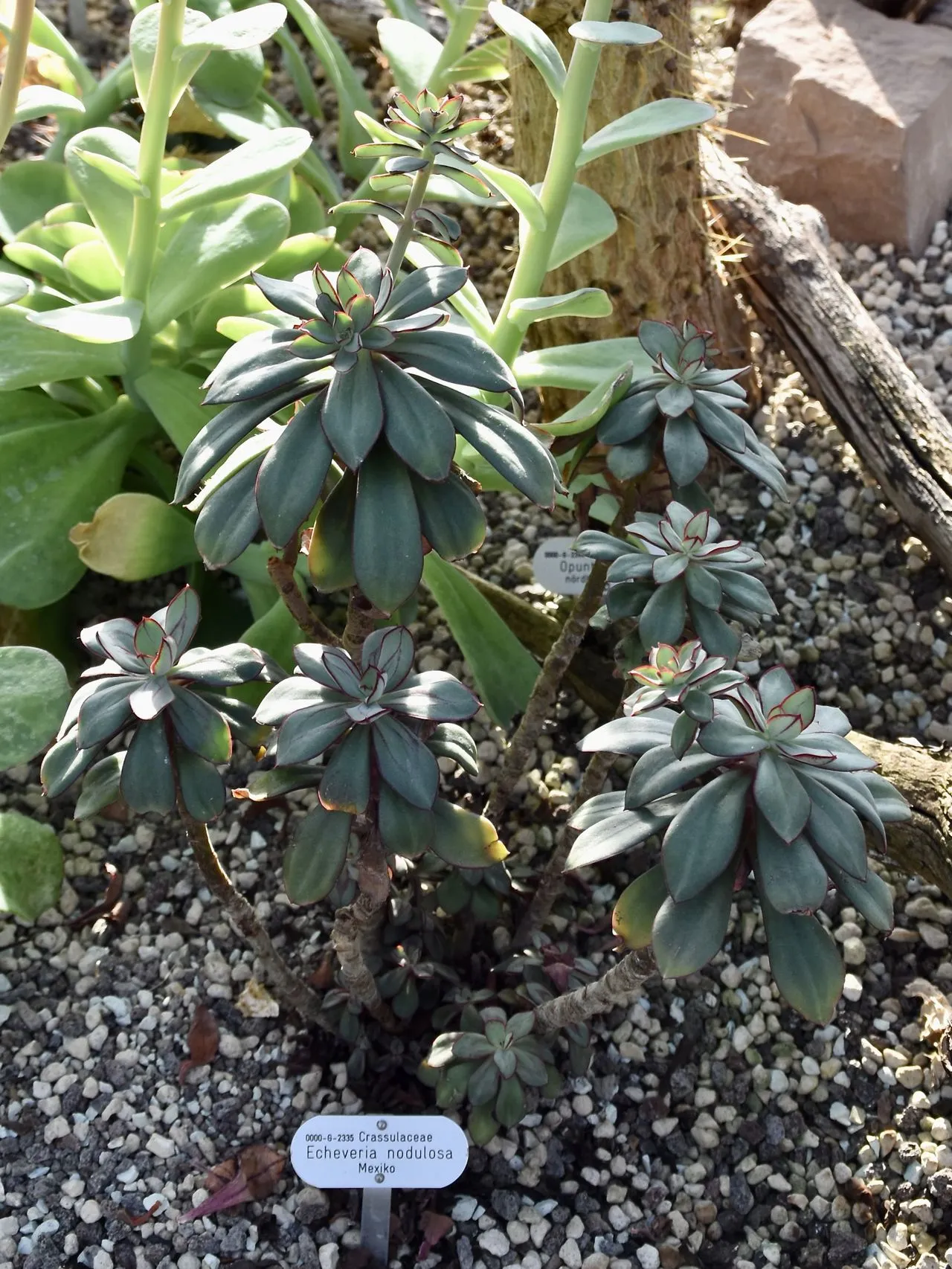
Echeveria nodulosa, the Painted Echeveria, was described by Joseph Nelson Rose in 1905 after earlier treatment as Cotyledon nodulosa Baker in 1869. It is native to Oaxaca, Mexico, where it grows on dry oak woodland slopes at about 1,400 m to 2,200 m, and it is recognised by pale green leaves painted with dark red-purple margins, a central keel, and irregular sun-stress blotches.
In habitat, E. nodulosa is not a flat rosette sitting on open desert gravel. It is a highland Mexican species from sloping, seasonally dry woodland, usually among mineral soil, leaf litter, rock fragments, and filtered light from oaks. Summer rain drives active growth; cooler, brighter winter conditions bring out the markings and prepare the plant for flowering. That origin explains two cultivation facts that matter in a pot: it wants more light than a shaded houseplant, but it also resents stale heat around wet roots.
Part of the Complete Echeveria Guide.
Identification
E. nodulosa is a stem-forming echeveria. Young plants may look like ordinary single rosettes, but mature plants develop a short woody stem and often lean as the rosette gains weight. In cultivation, an older plant can reach 25 to 40 cm in stem height if it is kept for several years rather than being cut back for propagation.
The rosette is looser and more architectural than that of compact species such as E. elegans. Leaves are usually 4 to 6 cm long, pale green to yellow-green, and slightly concave above. The important character is the painted surface. A well-lit plant carries dark red-purple pigment along the leaf margins, down the midline keel, and sometimes in broken blotches across the upper surface. The marks are not a uniform red edge like those of many hybrids. They look brushed on, especially when cool nights follow bright days.
Light changes the colour strongly. In weak indoor light, the plant may remain mostly green with narrow markings and a lengthening stem. Under bright exposure, the margin, keel, and irregular patches intensify to wine-red or purple-brown. This is a useful diagnostic clue, but it can also mislead buyers: a recently shaded E. nodulosa may look under-marked, while a stressed hybrid may look over-marked.
The flower scape is lateral, rising from the side of the rosette rather than from the centre. It bears a terminal cincinnus of tubular yellow-orange flowers, usually in winter to early spring. The rosette is polycarpic, so flowering does not kill the plant.
The common confusion point is Echeveria gibbiflora. That species is much larger, with broader, often wavy leaves and no painted midline or blotched pattern. A plant with a cabbage-like rosette and heavy leaves is unlikely to be true E. nodulosa. Trade names also blur the species. E. nodulosa 'Maruba' usually has rounder leaves, while 'Painted Beauty' is selected for wider, heavier markings. Those cultivars can be worth growing, but they should not be used as the standard for wild-type identification.
Cultivation
Give E. nodulosa bright light for colour and compact growth. Outdoors in warm climates, morning sun with light afternoon shade is a good starting point. Indoors, a south or west window is usually needed, with four to six hours of direct sun if the plant has been acclimated. The painted pigment intensifies when bright days are paired with cool nights around 8 °C to 14 °C. If the stem stretches quickly and new leaves are mostly green, the plant is not receiving enough light.
Do not move a shaded plant straight into hard midday sun. The green tissue between the pigmented margins can scorch before the plant has time to thicken its cuticle. Increase exposure over 10 to 14 days, especially after winter indoors or after buying a nursery plant grown under shade cloth.
Water deeply, then let the root zone dry. In active spring and summer growth, a 10 to 12 cm terracotta pot may need water every 7 to 12 days in warm weather. Use the plant rather than the calendar: water when the top 3 to 4 cm of substrate is dry and the lower leaves have softened slightly. In winter, when cool nights drive colour and flowering, water lightly every 3 to 5 weeks, only after the mix has dried through. If your general watering habits are still developing, the beginner's guide to succulents gives the broader method, but E. nodulosa needs the drier end of that range in cool weather.
Use a mineral-forward substrate with 60% to 75% pumice, lava grit, coarse perlite, or 3 to 6 mm crushed rock. The remainder can be a peat-free loam-based compost or a small amount of fine bark. A mix that remains damp for more than two days after watering is too water-retentive for this species in a normal home. The woody stem is not the weak point; the risk is a wet, oxygen-poor root ball under a top-heavy rosette.
Pot size should follow the root system, not the height of the stem. A single young plant grows well in an 8 to 10 cm pot. A mature, leaning plant may need a 12 to 14 cm terracotta pot for stability, but do not jump to a deep container full of slow-drying compost. If the stem has become awkward, support it with grit at the surface or reset the rosette as a cutting rather than burying a long woody stem in wet mix.
Keep established plants above 5 °C when possible. Dry plants can usually tolerate brief dips close to 0 °C, but the species is not a frost-hardy garden plant. Wet roots during cold weather cause more losses than the cold itself. In hot climates above 32 °C, provide moving air and light afternoon shade; heat plus stagnant wet substrate produces soft growth and root decline.
Propagation
Leaf propagation works, but it is less automatic than with the easiest echeverias. Choose mature, firm lower leaves in spring or early summer. Twist sideways until the whole leaf base detaches cleanly; a torn base rarely produces a rosette. Let the leaves callus for 4 to 6 days, then lay them on barely damp pumice in bright shade at 21 °C to 25 °C. Under those conditions, expect about 70% success, with roots and early plantlets appearing in 4 to 6 weeks.
Keep leaf trays dry from above. The pigmented leaf surface is not fuzzy, but the torn base still rots if it stays wet. I prefer to moisten the pumice lightly from one edge of the tray and let capillary movement carry humidity under the leaves. Once the new rosette is 1 to 2 cm across and the original leaf begins to shrivel, pot it into the same mineral mix used for adults.
Stem cuttings are the more predictable way to restore shape or multiply an older plant. Cut below the rosette with a clean blade, leaving 2 to 4 cm of stem attached. Let the cut dry in shade for 7 to 10 days, longer if the stem is thick or the weather is humid. Set the cutting upright in dry pumice, with only enough depth to hold it steady. At 20 °C to 25 °C, stem cuttings usually root in 2 to 3 weeks on dry pumice. Begin watering only after resistance is felt when the rosette is nudged gently.
The remaining rooted stump often produces side shoots. These can be left to form a branched specimen or removed once each shoot has several leaves and a small stem of its own. Seed is possible but not useful for preserving a named clone or a strongly marked plant, since seedlings vary in leaf width, pigment coverage, and growth habit.
Notes
The painted markings are anthocyanin-rich stress colour, not disease. They strengthen with light, cool nights, and leaner feeding, then fade when a plant is grown warm, shaded, and nitrogen-rich. Do not try to force colour by droughting the plant to the point of root loss. A firm, well-lit plant with moderate pigment is healthier than a shrivelled one with dark margins.
Mealybugs are the main pest on older specimens because the leaning stem and dry leaf bases give them shelter. Inspect the underside of the rosette and the junction between stem and old leaves. Aphids can gather on winter and early spring flower scapes; remove them before they distort the yellow-orange flowers.
Old plants often look untidy at the base. That is normal for a stem-forming species. You can keep the sculptural, leaning habit, or you can cut and reroot the rosette every few years. Both approaches are legitimate. What matters is that the plant is labelled correctly, because E. nodulosa is often sold beside hybrids whose red markings are broader, flatter, or too symmetrical for the species.
See also
- Complete Echeveria Guide — genus-level substrate, dormancy, and propagation principles.
- Echeveria gibbiflora — the much larger species most likely to be confused with poorly marked plants.
- Echeveria runyonii — a glaucous, sculptural species useful for comparing rosette form without painted leaf markings.
Frequently Asked Questions
Why are Echeveria nodulosa leaves marked red?
The red-purple lines and blotches are anthocyanin-rich stress colour. They intensify with light, cool nights, and lean feeding.
How tall does Echeveria nodulosa get?
Older plants can develop woody stems 25 to 40 cm tall if they are kept for several years instead of being cut back.
How do you propagate Echeveria nodulosa?
Leaf propagation works at about 70 percent from cleanly removed leaves. Stem cuttings are more predictable for resetting older leaning plants.
Is Echeveria nodulosa the same as Echeveria gibbiflora?
No. E. gibbiflora is much larger, with broader leaves and no painted midline or blotched pattern.