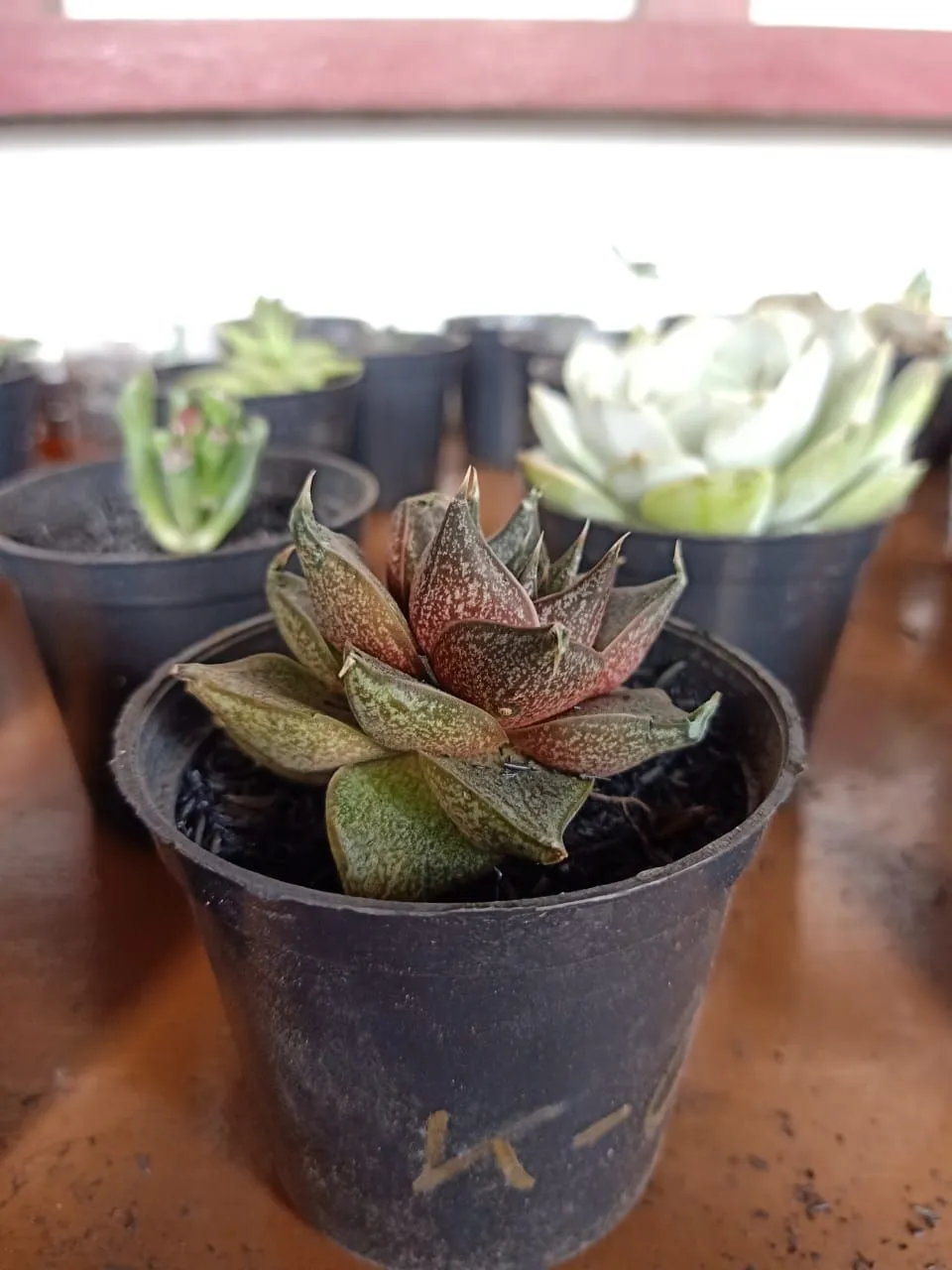
Echeveria purpusorum wants bright light, fast-draining soil, and a dry rhythm between waterings. Keep the pot gritty and the roots on the dry side, and it stays compact instead of sulking.
| Question | Short Answer |
|---|---|
| How big does Echeveria purpusorum get? | A true plant usually stays 5 to 8 cm across and rarely exceeds 10 cm, even when old. |
| How is Echeveria purpusorum different from Echeveria agavoides? | E. |
| Can Echeveria purpusorum grow from leaves? | Yes, but slowly. |
| Does Echeveria purpusorum need much fertilizer? | No. |
Echeveria purpusorum (Rose) A.Berger was published in 1909 from material worked by Joseph Anton Purpus and Alwin Berger, and the binomial honours the Purpus brothers, German botanists active in the Mexican highlands at the turn of the twentieth century. The species sits at the agavoid edge of the genus: a small, stemless, slow-growing rosette of unusually thick, broadly triangular leaves marked with red-purple speckling on a dark olive-green ground.
In habitat, E. purpusorum is restricted to the Tehuacán Valley in Puebla, on exposed limestone outcrops between roughly 1,500 m and 2,000 m. The substrate is shallow, alkaline, and almost purely mineral; rainfall comes in a short summer pulse and the rest of the year is dry. Those conditions explain the thick water-storing leaves, the compact rosette, the strong terminal spine, and the genuinely slow growth rate, which is comparable to E. cante and unusual among the species you find on a beginner's shelf.
Part of the Complete Echeveria Guide.
Identification
E. purpusorum is one of the easiest echeverias to recognise once you know the leaf profile. The rosette is tight, stemless, and flat to the substrate, typically 5 to 8 cm across at maturity, and rarely exceeds 10 cm even in old plants. Offsetting is sparse; a healthy plant produces one or two basal pups every couple of years, not the cushion of clones that E. derenbergii or E. elegans produce.
The leaves are the diagnostic feature. They are 3 to 5 cm long, broadly triangular, and distinctly thicker at the base than typical Echeveria leaves. Run a finger along the upper surface and the leaf reads almost agavoid: a flat to slightly concave upper face, a strongly keeled lower face, and a hard, sharp terminal mucro. The colour is dark olive to dark blue-green under bright light, scattered with irregular red-purple to maroon flecks and short streaks across the upper surface. The speckling is heavier near the leaf tip and on younger leaves at the centre of the rosette, fading on older outer leaves. There is no red margin running the length of the edge; the colour pattern is surface speckling, not a rim.
In spring, established plants throw a 15 to 25 cm lateral scape carrying a small cincinnus of urn-shaped flowers. The corolla is pink-coral on the outside, paler at the tips, with a yellow throat. Flowering is reliable from age four or five onward in well-grown plants and does not damage the parent rosette.
Distinguishing from the obvious lookalikes:
- Echeveria agavoides shares the agavoid leaf profile and the strong terminal spine, but matures at 8 to 15 cm across (sometimes larger), the leaves are more uniform mid to bright green, and surface speckling is usually absent or much fainter than in E. purpusorum. If the rosette is bigger than a tennis ball and the leaves read clean green, the plant is almost certainly E. agavoides or one of its hybrids.
- Echeveria pulidonis carries a continuous red margin running the full edge of each leaf, and the leaves are longer (4 to 6 cm), narrower, and held in a flatter, less compact rosette. There is no surface speckling on the leaf face. A red rim says E. pulidonis; surface flecks on a dark ground say E. purpusorum.
- Echeveria elegans is pure pale blue-white under a heavy waxy bloom, with rounded obovate leaves and a much softer outline. It carries no red colour at all in good health, and its rosette is rounded rather than triangular in profile.
When in doubt, the combination of small (under 10 cm) stemless rosette, broadly triangular thick leaves with a sharp terminal spine, and red-purple surface speckling on a dark olive-green ground separates E. purpusorum from anything else in trade.
Cultivation
Light should be bright but not full midday tropical sun. Four to six hours of direct sun, ideally morning or late afternoon, brings out the dark olive ground colour and intensifies the red-purple speckling. Indoors, an unobstructed south or southeast window suits the species well; an east window is acceptable but the leaves will read greener and the speckling lighter. In low light the rosette opens at the centre, the leaves go flat green, and the species loses much of what makes it interesting. The thick leaves resist sunburn better than thinner echeverias, but a plant moved from a windowsill to outdoor full sun in summer still needs ten to fourteen days of staged acclimation.
Water on a clear cue and err dry. The thick triangular leaves store a long buffer of water and the species is genuinely intolerant of wet feet, more so than the sibling species in this genus. In active growth (spring and early summer, again in early autumn), water deeply once the top 3 to 4 cm of the substrate is dry and the lower leaves have lost a perceptible fraction of their firmness. For a single rosette in a 7 to 9 cm terracotta pot, that is roughly every 10 to 16 days in warm weather. In winter, drop to a single light watering every 5 to 6 weeks if the plant sits at room temperature, and stop entirely below 8 °C. Wet the substrate, never the rosette, since the dense leaf packing holds water at the crown for a long time.
Substrate should be 70% to 80% mineral, on the higher end for the genus. A working blend is pumice or 3 to 6 mm lava grit with the remainder a peat-free loam-based compost; a small fraction of crushed limestone grit is appropriate and matches the habitat. The pot must be fully dry inside 48 hours after a thorough watering. Use a shallow terracotta pot 7 to 9 cm wide for a single plant; the root system is small and a deep pot holds wet substrate below the roots that does the plant no favours. The growth rate is slow enough that a well-grown plant only needs repotting every three to four years.
Temperature tolerance follows the highland Mexican pattern. Steady growth runs between 8 °C and 28 °C. Dry plants take brief dips to 0 °C without damage, and brief exposure to about minus 2 °C causes only cosmetic leaf-tip browning. Keep the substrate bone-dry below 5 °C and provide moving air whenever night temperatures sit close to dew point. In summer above 32 °C, give afternoon shade and ventilation; the species shrugs off heat better than cold-loving alpine succulents but small pots overheat fast.
Feeding is light. One dilute, low-nitrogen feed in mid-spring is enough for a season in fresh substrate. Heavy nitrogen produces large, soft, paler leaves and dilutes the red-purple speckling, which is the wrong outcome for this species. The general watering and feeding rhythm in the beginner's guide to succulents sets out the method that the cultivation notes above refine for E. purpusorum.
Propagation
This is one of the slower echeverias to propagate, and the offset and seed routes are both demanding for different reasons.
Offset division is the cleanest method, when offsets exist. A mature plant produces only one or two pups per year, so the supply is limited. Once an offset is rooted and roughly a third the width of the parent, twist or cut it free with a clean blade, callus the wound for 5 to 7 days in shade, and set it on dry mineral mix. Resume light watering after about two weeks. Success on rooted offsets runs above 90%. Unrooted pups should be calloused for closer to ten days before any contact with damp substrate.
Leaf propagation works but is slow and inconsistent. The thick, firmly attached leaves are difficult to detach cleanly; a torn base loses every leaf. With cleanly twisted leaves, callus for 6 to 8 days, lay on barely damp pumice in bright shade at 22 °C to 26 °C, and expect roots and a tiny rosette in 6 to 10 weeks. Success runs around 50% to 65%, well below E. derenbergii or E. elegans. The new rosette reaches potting size in 8 to 12 months.
Seed is the route used by specialist nurseries. Fresh seed germinates over 2 to 4 weeks at 22 °C on a sterile mineral-based mix; seedlings reach 1 cm across in their first year and a recognisable identification-grade rosette in three to four years. The species is self-incompatible enough that hand pollination between unrelated plants improves seed set noticeably.
Notes
The most common confusion in trade is with Echeveria agavoides and its hybrids. Many "E. purpusorum" plants on garden-centre shelves are actually small E. agavoides clones or unnamed crosses; the giveaway is rosette size at maturity (over 10 cm), uniform leaf colour with little or no surface speckling, and faster offsetting. A plant that has tripled in size inside a year is not E. purpusorum.
The species has been used as a parent in several well-known hybrids. E. purpusorum x E. agavoides gives 'Sirius' and similar plants that combine the dark speckling with a larger, agavoid rosette. Hybrids with E. cante and E. colorata circulate under various commercial names. None of these are the species itself, and any hybrid loses the strict 5 to 8 cm size limit.
Pests are conventional. Mealybugs find the dense crown and the bases of offsets and are easy to miss until populations are large; inspect new plants and lift rosettes to check the substrate surface every few months. Root mealybug is a more serious risk in old, dry, mineral substrate and is a common reason for sudden decline in long-established plants. Aphids on flower scapes clear with a hose rinse. Fungal crown rot is uncommon in well-drained substrate but follows quickly if water sits in the rosette in cool weather.
E. purpusorum is not toxic to humans, dogs, or cats in any meaningful sense. The terminal spine on each leaf is firm enough to draw blood from a careless handler, which is unusual for the genus and worth noting before bare-handed repotting.
See also
- Complete Echeveria Guide — genus-level substrate, light, and propagation principles.
- Echeveria pulidonis — separated by red leaf margins instead of surface speckling.
- Echeveria agavoides — a close visual relative at two to three times the rosette size.
Frequently Asked Questions
How big does Echeveria purpusorum get?
A true plant usually stays 5 to 8 cm across and rarely exceeds 10 cm, even when old.
How is Echeveria purpusorum different from Echeveria agavoides?
E. purpusorum is smaller, darker, and speckled. E. agavoides is larger, cleaner green, and lacks the same red-purple surface flecking.
Can Echeveria purpusorum grow from leaves?
Yes, but slowly. Clean leaves root at about 50 to 65 percent and plantlets may need 8 to 12 months to reach potting size.
Does Echeveria purpusorum need much fertilizer?
No. One dilute low-nitrogen feed in mid-spring is enough, because heavy feeding produces soft pale leaves and dilutes the speckling.