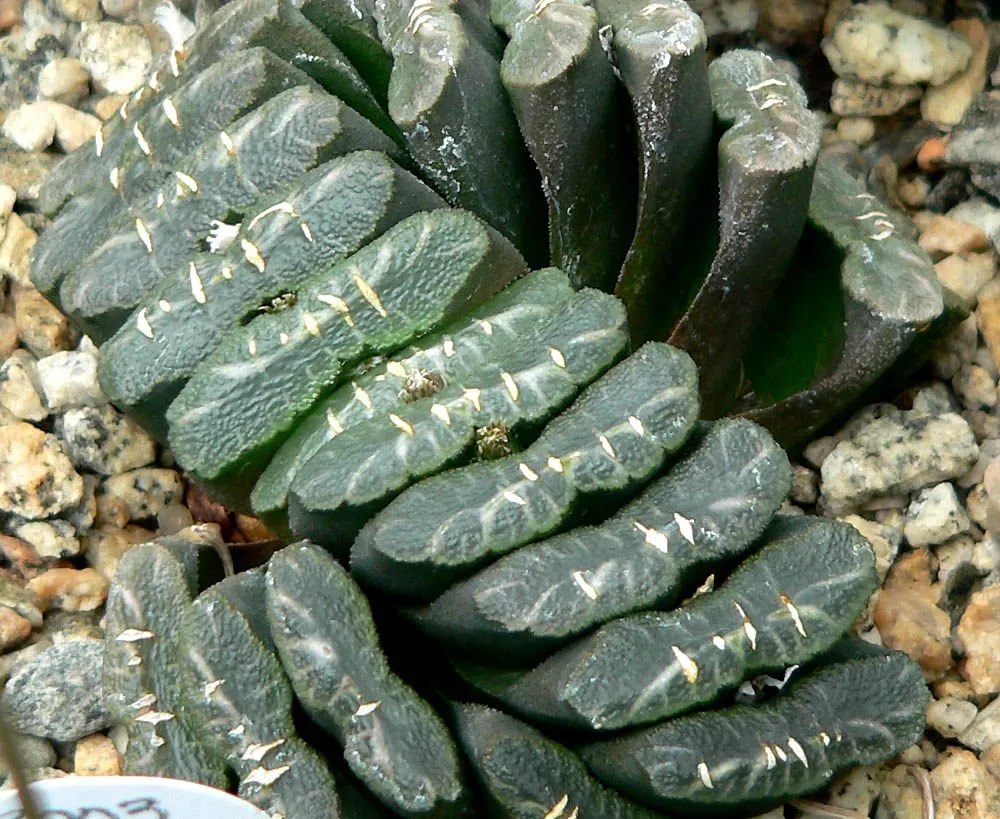
Soft, mushy tissue on a Haworthia is an emergency. The genus is built for drought, not waterlogging, and when its leaves lose their structural rigidity and collapse into a translucent, water-saturated state, the cause is almost always rot. The critical question is where the rot originates — roots, stem base, or crown — because each site has a different prognosis and a different intervention. Acting on the correct site in the first 24 hours makes the difference between full recovery and losing the plant.
Part of the Complete Haworthia Guide.
Root rot — mushy from the base upward
Root rot is the most common origin of soft, mushy leaves in Haworthia, and it begins invisibly below the substrate surface. Anaerobic conditions in a waterlogged medium — caused by poor drainage, too-frequent watering, a pot too large for the root mass, or cold temperatures below 12 °C that slow root respiration — allow root-pathogenic oomycetes and fungi (Pythium spp., Phytophthora spp., Fusarium spp.) to colonise the root tissue. Healthy roots die and are replaced by blackened, hollow sheaths. Water uptake fails. The outer leaves, cut off from the hydrostatic supply that keeps them plump and firm, gradually soften.
The initial softening is subtle — the leaves feel less crisp than usual, slightly yielding when pinched, but still retain their shape. Within several days to two weeks, the softening progresses: the leaves become fully mushy and translucent, often yellowing as chlorophyll breaks down simultaneously. There may be a faint sour or fermented smell from the soil surface or the stem base. The substrate may appear surface-dry even when the root zone remains saturated, because waterlogged soil does not drain efficiently.
Diagnosis: Unpot the plant. Root rot roots are black or dark brown, often hollow, and slide off the root collar without resistance. Press the stem base between thumb and finger — if it yields, rot has advanced from the roots into the stem and the intervention needs to include cutting into clean stem tissue. If the stem is still firm and white at the cut point, the plant is recoverable. The complete inspection and recovery procedure is in root rot diagnosis.
Stem-base rot — mushy where leaves meet the stem
Stem-base rot is distinct from root rot in mechanism, though the two frequently coincide. When water pools persistently in the lower leaf axils — where the base of each leaf presses against the stem — the sustained moisture at that junction creates an entry point for fungal pathogens. Stem rot at the leaf bases typically produces a grey or dark brown discolouration at the attachment point before the tissue collapses. Affected leaves are soft and mushy at the base but may still be firm toward their tips, which distinguishes this from drought shriveling (uniform across the leaf) or root rot (starts at the outermost leaves and progresses inward).
This pattern is most common in plants watered overhead rather than at the substrate surface, or in plants whose crowns have collected water during cleaning or rain. Haworthia cooperi and H. cymbiformis, with their dense leaf arrangements, are more susceptible than more open Haworthiopsis species because their compact geometry traps water more readily.
If stem-base rot is caught early — only one or two leaves affected and the main stem still completely firm — remove the affected leaves cleanly at their attachment points. Allow the exposed sites to air-dry for 48 hours in shade with good airflow. Dust with powdered sulfur if available. Do not water from above again. Monitor closely for spread over the following two weeks. The full stem-rot examination protocol is in stem rot diagnosis.
Crown rot — mushy at the growing point
Crown rot is the most serious of the three rot sites. The growing point of a haworthia is at the exact centre of the rosette — the tight cluster of new, not-yet-unfolded leaves at the top of the stem. When water pools there — from overhead watering, condensation in enclosed terrariums, or cup-shaped containers without drainage — crown rot can advance within 48 hours in warm conditions above 20 °C. The first sign is sudden softening of the innermost leaves, which were previously the firmest part of the rosette. They become translucent, collapse inward, and smell sour. Within days, the growing point itself fails.
Prognosis for crown rot is poor. Once the meristem is destroyed, the rosette cannot regenerate. It does not have the diffuse regenerative capacity of a stem or root. The only recovery option is to check whether the plant has produced any offsets at the base with their own rooting points. If so, remove healthy offsets with a sterile blade, allow them to callus in shade for 5 days, and pot them independently in fresh dry mineral mix. They will grow into new rosettes. The parent rosette with a destroyed crown is not salvageable and should be discarded before secondary rot spreads to the offsets.
Other causes of mushy texture
Not all mushy haworthia leaves originate from rot. Two non-pathogenic conditions produce similar texture:
Turgor overload from extreme rainfall. A plant caught in sustained heavy rain in a pot without adequate drainage can develop temporary cellular overhydration — the cells take in more water than they can structurally manage and become engorged, soft, and semi-transparent. This resolves on its own: move to shelter, allow to drain fully, and leaves typically firm up within 48 hours if no secondary infection establishes in the meantime.
Frost and cold damage. Cells ruptured by ice crystal formation within the leaf become mushy once they thaw. Cold-damaged tissue is identifiable by context: if temperatures dropped below 0 °C in the preceding 24–72 hours, cold damage is the likely cause. Frost-damaged leaves are soft and collapse but typically do not smell sour unless secondary fungal infection follows. Remove only fully collapsed leaves; allow firm-but-brown cold-damaged tissue to dry on its own rather than cutting prematurely.
A related but distinct symptom — shriveling rather than mushiness — may indicate drought or root mealybug rather than rot. See haworthia leaves shriveling for the differential between those causes.
How to identify the rot site
| Where mushy | Smell | Substrate condition | Interpretation |
|---|---|---|---|
| Outer and lower leaves only, soft at the leaf base | Faint sour | Wet or recently wet | Root rot — unpot immediately |
| At leaf attachment points on main stem | Faint musty | Any | Stem-base rot — remove affected leaves |
| Centre new leaves, innermost tissue | Sour | Any | Crown rot — check for offsets, discard parent rosette |
| All leaves simultaneously, recent cold event | None or minimal | Normal or any | Frost damage — move to warmth, do not water |
| All leaves, appeared after rain, no smell | None | Waterlogged | Turgor overload — drain and shelter |
Risk and severity
Root rot caught before stem involvement: fully recoverable with correct treatment. Stem-base rot limited to one or two leaf bases with a firm main stem: recoverable with leaf removal and drying. Crown rot at the growing point: not recoverable for the main rosette; save offsets only. Turgor overload and frost damage without secondary infection: recoverable once the adverse conditions are removed.
The decisive assessment is always the firmness of the stem below the leaf line. A firm stem means the plant's structural core is intact and there is time to act correctly. A mushy or yielding stem means decay has moved into the main axis of the plant. Cut upward with a sterile blade into clean firm tissue and treat the remaining portion as a cutting, callusing for 5–7 days before potting.
Solutions
Root rot
Unpot and remove all substrate. Cut roots back to clean, firm tissue with a sterile blade. If any stem tissue is soft, cut upward into clean white tissue and treat the plant as a cutting. Dry bare-root in a well-ventilated, shaded position for 5–7 days. Repot into fresh, dry mineral mix (60% pumice, perlite, or coarse grit minimum). Withhold water for 7–10 days. Resume a correct dry-down watering cycle; guidance is in wet-dry cycle explained.
Stem-base rot (early stage)
Remove affected leaves at their base. Allow attachment sites to air-dry for 48 hours in good airflow. Apply powdered sulfur if available. Move to a position with better air circulation. Do not water overhead. Monitor daily for two weeks.
Crown rot
Confirm the growing point is destroyed by pressing — it will yield completely. Remove any healthy offsets at the base, taking a small section of connecting tissue. Callus offsets for 5 days in shade. Pot in fresh dry mineral mix. The parent rosette is not salvageable.
Turgor overload
Move to shelter. Allow drainage. Do not water. Leaves firm up within 48 hours without intervention.
Frost damage
Move immediately to above 10 °C. Do not water for at least two weeks. Remove only fully collapsed leaves — firm-but-brown cold-damaged tissue is better left to dry in place.
Prevention
Never allow water to pool in the rosette centre. Water at the substrate surface only — never overhead or from above. Use a mineral-dominant substrate that completes its dry cycle within 7–14 days at indoor temperatures (20–22 °C). Choose a pot only 1–2 cm wider than the root ball: oversized pots retain moisture disproportionately. Reduce watering frequency when temperatures drop below 12 °C — the plant uses water far more slowly in cool conditions and a wet substrate below 12 °C is the single most consistent recipe for root rot. Inspect the base of the rosette monthly for the early, slightly-soft feeling that precedes visible collapse. A plant caught at the "slightly less crisp" stage has a far better prognosis than one already in full translucent collapse.
See also
- Root rot diagnosis — the complete root inspection, cutting, and recovery procedure for succulents including bare-root drying and repotting protocol.
- Haworthia leaves shriveling — the related symptom of shriveling driven by the same root causes, and how to distinguish it from mushiness.
- Stem rot diagnosis — stem-base examination and treatment when the root system is intact but the collar is compromised.
Frequently Asked Questions
What does Haworthia root rot feel like?
The outer leaves feel soft, slightly squashy, and may be translucent rather than firmly opaque. The substrate smells faintly sour. When the plant is unpotted, the roots are black or brown, hollow, and pull away without resistance. Healthy roots are firm and pale tan to white.
Can a Haworthia with mushy leaves be saved?
Yes, if the mushiness is in the outer leaves and the stem base and crown are still firm. Cut all dead roots, dry bare-root for 5–7 days, then repot. A plant where the centre growth point is mushy has crown rot and is unlikely to survive, but any firm offsets at the base can be saved and grown on.
How quickly does Haworthia root rot progress?
Root rot caused by Pythium or Phytophthora can advance from root tips to stem base in 7–14 days in warm, wet conditions. In cool conditions the progression is slower but still continuous. Treat on the same day the problem is identified.
Should I water a Haworthia with mushy leaves?
No. Do not add any water until the root problem is diagnosed and treated. Additional watering into an active rot situation accelerates the decay and eliminates any remaining firm root tissue.